Combination Skin Care Routine: Your Daily Solution for 2026

Discover the ultimate combination skin care routine for 2026. Expert tips, product picks, and step-by-step guidance. Start your routine today.
If your forehead shines by noon while your cheeks feel tight and flaky, you are not imagining things; you likely have combination skin, one of the most common and most misunderstood skin types. A well-built combination skin care routine treats the oily T-zone and the drier cheeks as two different neighborhoods that happen to share one face, rather than forcing a single product to do an impossible job everywhere at once.
In this article, you’ll learn:
- What combination skin actually is and how to confirm you have it
- The correct combination skin care routine order for morning and evening
- Which cleansers, toners, serums, and moisturizers actually work for mixed skin
- A zone-by-zone framework you won’t find on most beauty blogs
- The most common combination-skin mistakes that quietly sabotage results
- Answers to the questions people ask most about combination skin
This is one of the most detailed, practically tested guides to a combination skin care routine available right now. Bookmark it, because you’ll want to come back to the product tables and the step-by-step plan.
Table of Contents
- What Is a Combination Skin Care Routine?
- How Do I Know If I Have Combination Skin?
- Why a Combination Skin Care Routine Matters in 2026
- The Combination Skincare Routine Order: Step-by-Step
- Best Products for Combination Skin, by Category
- Combination Skin Care Routine Comparison: Top Options
- Common Combination Skin Mistakes to Avoid
- Combination Skin Care Routine for Men
- Real-World Example: A 6-Week Case Study
- Expert Tips to Master Your Combination Skin Care Routine
- FAQ
What Is a Combination Skin Care Routine?
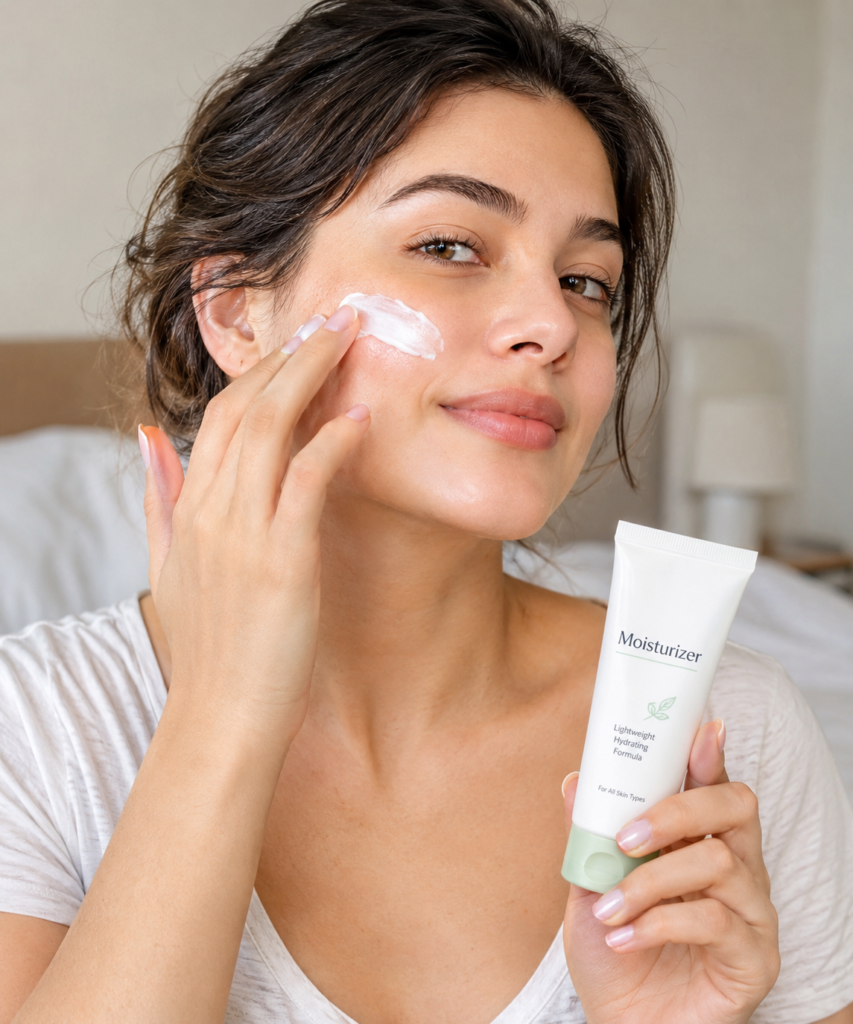
A combination skin care routine is defined as a skincare regimen that treats different zones of the face differently — typically balancing oil control across the forehead, nose, and chin (the T-zone) while adding hydration to the cheeks, jawline, and around the eyes, which tend to run drier. Rather than one product for the whole face, it relies on layering and, sometimes, applying different formulas to different areas.

What is combo skin, exactly? Combination skin is a skin type in which two or more zones of the face behave differently: oily or shiny in some areas, normal or dry in others. It is not a diagnosis or a condition; it is simply how your skin’s oil (sebum) production varies across your face, largely driven by the density of sebaceous glands, which is naturally higher around the nose and forehead.
Skincare for combination skin differs from routines built for purely oily or purely dry skin because it has to solve two problems in one routine without one product undoing the other: a heavy cream that fixes dry cheeks can clog pores on an oily nose, and a mattifying gel that controls shine can leave cheeks feeling stripped.
How Do I Know If I Have Combination Skin?
How do I know if I have combination skin? The simplest test is the blotting-sheet method: wash your face, wait an hour without applying anything, then press a blotting paper against your forehead, nose, chin, and cheeks separately. If the paper picks up noticeably more oil from your T-zone than from your cheeks, you have combination skin.
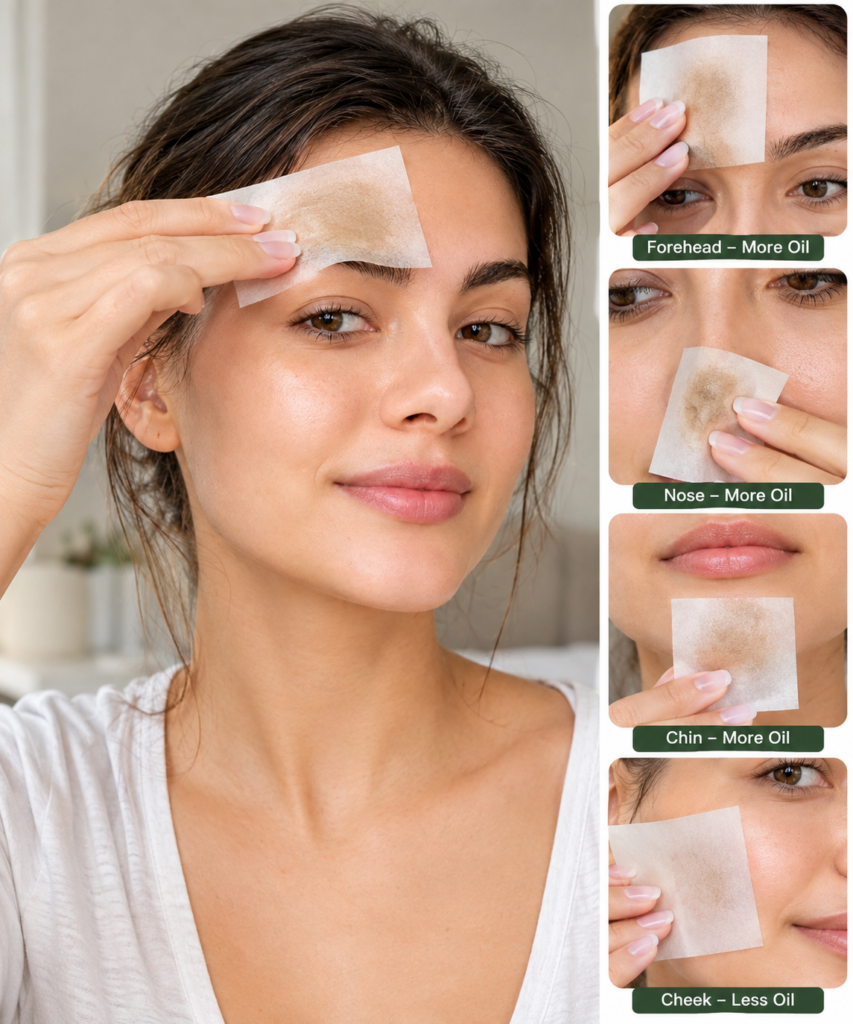
Other everyday signs of combination skin include:
- A shiny or oily T-zone by midday, even after cleansing
- Cheeks that feel tight, flaky, or dull, especially after cleansing
- Pores that look larger on the nose and forehead than elsewhere
- Occasional breakouts concentrated around the nose and chin
- Makeup that slides off the T-zone faster than it does on the cheeks
Pro Tip: Track your skin at two different times of day for a week: morning and mid-afternoon. Combination skin often looks almost normal in the morning and only reveals its true pattern by early afternoon, which is why so many people misdiagnose themselves as having “normal” or “oily” skin.
Why a Combination Skin Care Routine Still Matters in 2026
Skincare in 2026 has moved toward skin zoning, treating the face as a map of micro-climates rather than one uniform surface. Multiple dermatology associations, including guidance published by the American Academy of Dermatology, note that combination skin is one of the most frequently self-reported skin types, alongside oily and dry, which means most generic “one type fits all” product lines are built around an oversimplified picture of how skin actually behaves.
A mismatched routine does real, cumulative damage. Using a heavy, rich moisturizer across the entire face can worsen T-zone congestion and contribute to clogged pores over time, while over-drying products used on the whole face can trigger the cheeks to compensate by producing more oil, a cycle dermatologists sometimes describe as reactive sebum production. Combination skin care routine planning exists specifically to break that cycle.
Expert Insight: “The biggest mistake I see is treating combination skin like it’s just mildly oily skin,” notes a common refrain among licensed estheticians. “It needs a genuinely zoned approach, not a slightly gentler version of an oily-skin routine.”
The Combination Skincare Routine Order: Step-by-Step
Here is the correct combination skincare routine order for both morning and evening, built around zoning rather than uniform application.
Morning Combination Skin Care Routine
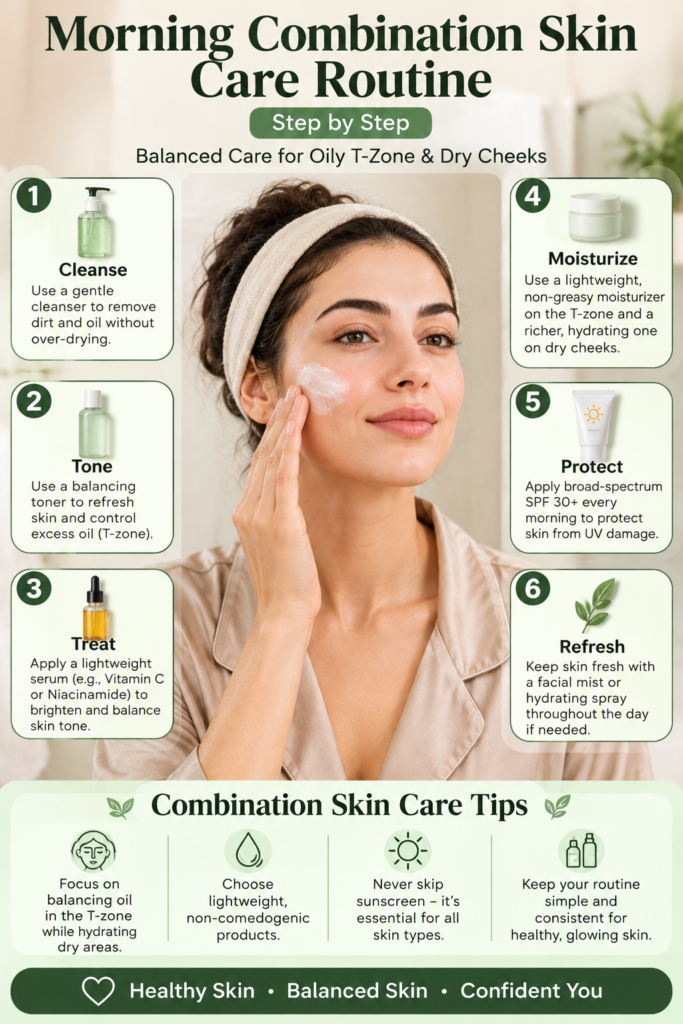
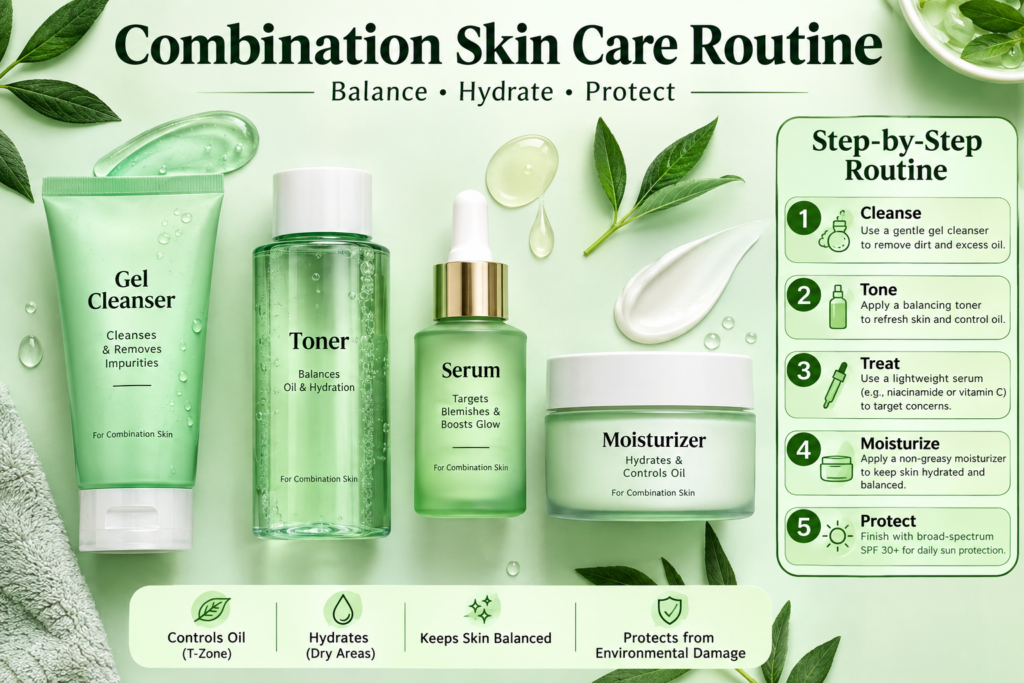
- Cleanse — Use a gentle, low-foam gel or cream cleanser across the whole face. Avoid harsh foaming cleansers that strip the cheeks. A mild gel or foaming cleanser (avoid harsh sulfates). Cleanse the whole face, but you can go lighter on the cheeks if they’re tight or flaky.
- Tone — Apply a hydrating, alcohol-free toner to the whole face; follow with a second, lightly astringent pass (like a witch-hazel or niacinamide toner) only on the T-zone.An alcohol-free, hydrating toner (look for niacinamide, witch hazel, or hyaluronic acid) helps balance oil in the T-zone without drying the cheeks.
- Treat — Apply a niacinamide or vitamin C serum across the whole face; niacinamide in particular helps regulate oil production in the T-zone while still supporting the skin barrier on the cheeks.
- Moisturize by zone — Use a lightweight, gel-based moisturizer on the T-zone and a richer, cream-based moisturizer on the cheeks and jawline. Lightweight, oil-free/gel moisturizer overall, or a “multi-masking” approach: gel formula on the T-zone, slightly richer cream on the cheeks.
- Protect — Finish with a broad-spectrum SPF 30+ every single morning, regardless of season. (SPF 30+) – Non-comedogenic. This is non-negotiable regardless of skin type.
Evening Combination Skin Care Routine
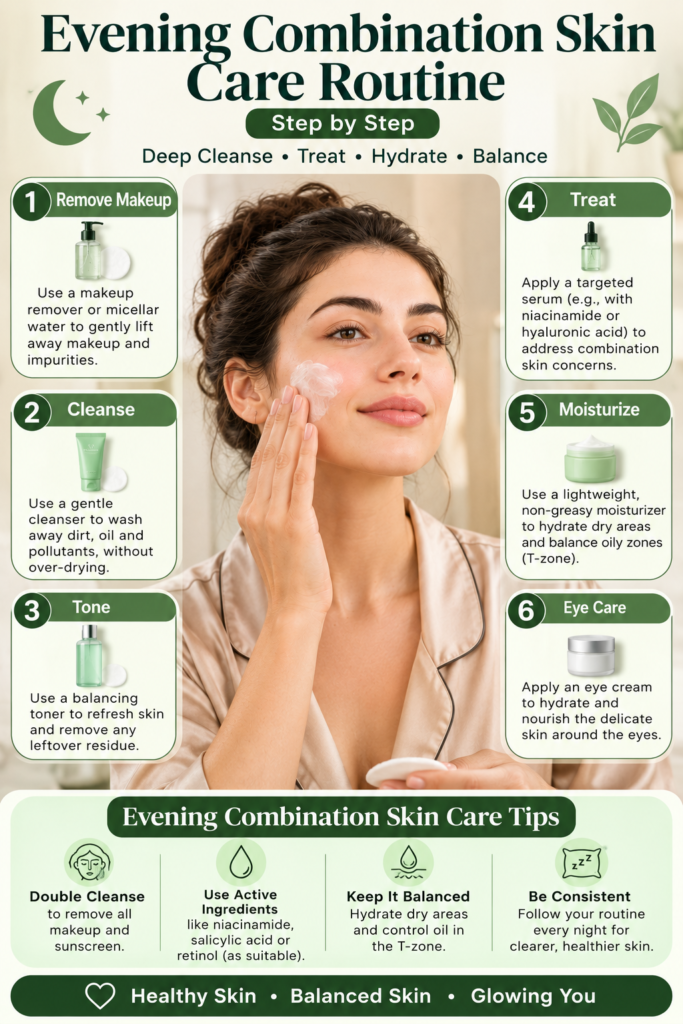
- Double cleanse — Remove sunscreen and makeup with an oil or balm cleanser, then follow with your gentle gel cleanser.
- Exfoliate (2–3x per week) — Use a chemical exfoliant (salicylic acid works especially well on the T-zone; a mild lactic acid suits the cheeks) rather than a physical scrub.(2–3x/week) – Exfoliating acid (BHA like salicylic acid is great for the oily T-zone; a mild AHA like lactic acid suits drier cheeks) alternate nights, not both at once.
- Tone — Same hydrating toner as the morning routine.
- Treat — This is the slot for targeted actives: retinoids, spot treatments, or hydrating serums, applied by zone as needed. Same as morning, or a retinoid at night (start 2x/week and build up) for texture and pore control.
- Moisturize by zone — Slightly richer at night than in the morning, still split between a lighter gel for the T-zone and a heavier cream for the cheeks. Slightly richer at night since skin repairs while you sleep; still avoid heavy, pore-clogging creams on the T-zone.
Pro Tip: If zoning two separate moisturizers feels like too many steps, apply one lightweight, non-comedogenic moisturizer everywhere first, then layer a few extra dots of a richer cream only on the cheeks while your skin is still slightly damp.
Your daily skin care guide
Best Products for Combination Skin, by Category
Best cleanser for combination skin: Look for a gel or gel-cream cleanser with a neutral-to-slightly-acidic pH that removes oil without leaving the cheeks feeling tight. Ingredients like glycerin and mild surfactants (as opposed to sulfates) tend to work best.
Combination skin toners & treatments: A layered toning approach one hydrating pass across the whole face, one lightly balancing pass on the T-zone tends to outperform a single all-purpose toner. Niacinamide, panthenol, and hyaluronic acid are the workhorse ingredients here.
Best moisturizer for combination skin: The honest answer is often “two moisturizers,” but if you want one product, a gel-cream hybrid with ceramides and hyaluronic acid is the closest thing to a universal fit — light enough for the T-zone, hydrating enough for the cheeks.
How do I pick a serum for combination skin? Prioritize niacinamide (oil regulation plus barrier support), hyaluronic acid (hydration without heaviness), and, if you’re targeting texture or breakouts, a low-percentage salicylic or azelaic acid serum used only on the T-zone.
The Zone Priority Framework™
This is an original framework worth naming, because it solves the single biggest confusion around combination skin: which product goes where. The Zone Priority Framework™ ranks every product decision by a simple rule: treat the T-zone for oil control first, then treat the cheeks for hydration second, and only choose a single “compromise” product when a two-product approach genuinely isn’t practical (like during travel). In practice, this means:
- T-zone priority: oil control, pore care, mattifying textures
- Cheek priority: barrier repair, hydration, gentle actives
- Shared priority: SPF, antioxidants, and gentle cleansing apply to the whole face equally
Combination Skin Care Routine Comparison: Top Options at a Glance
| Option Name | Key Feature | Best For | Price Range (USD) | Rating |
|---|---|---|---|---|
| Gel-Cream Moisturizer | Lightweight hydration with ceramides | Whole-face daily use, mild combination skin | $18–$35 | 4.5/5 |
| Niacinamide Serum (10%) | Regulates oil, supports barrier | T-zone oil control | $10–$25 | 4.6/5 |
| Dual-Zone Moisturizing Kit | Two formulas, one for T-zone, one for cheeks | Pronounced combination skin | $25–$50 | 4.7/5 |
| Salicylic Acid Spot Treatment | Targets clogged pores | T-zone breakouts only | $8–$18 | 4.3/5 |
| Rich Ceramide Cream | Deep barrier repair | Cheeks and jawline, dry zones | $20–$45 | 4.4/5 |
Winner: For most people managing a true combination skin care routine, the Dual-Zone Moisturizing Kit category wins; it directly reflects how combination skin actually behaves, rather than asking one formula to compromise across two very different needs.
Common Combination Skin Mistakes to Avoid
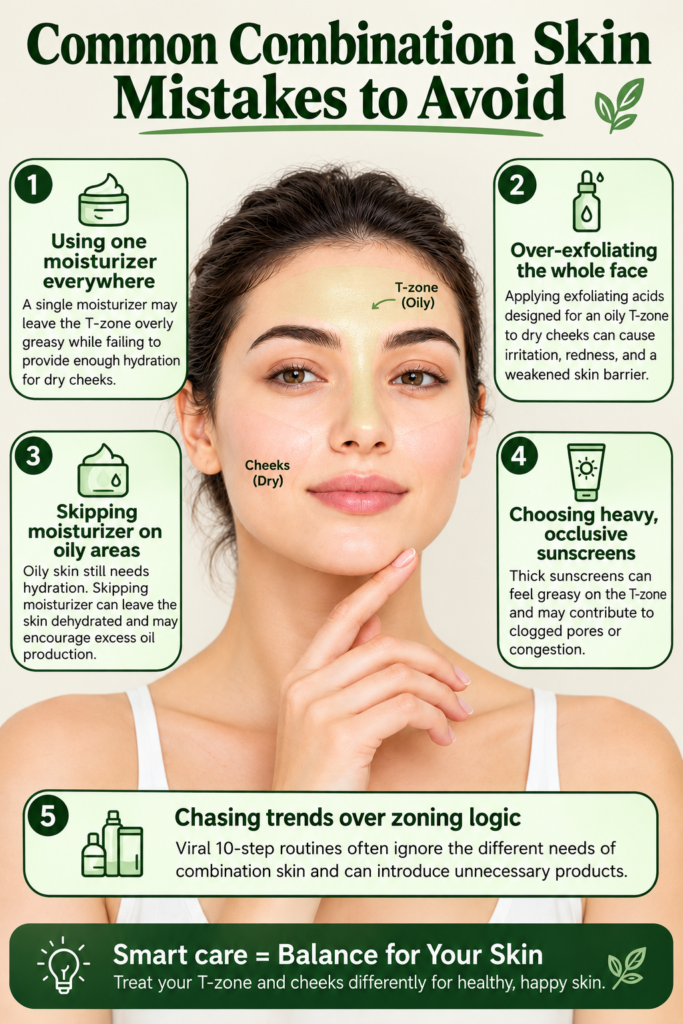
The most common mistakes people make with a combination skin care routine are surprisingly consistent:
- Using one moisturizer everywhere — This is the single biggest error, forcing either over-hydration on the T-zone or under-hydration on the cheeks.
- Over-exfoliating the whole face — Exfoliating acids meant for an oily T-zone, when applied to already-dry cheeks, cause irritation, redness, and a compromised barrier.
- Skipping moisturizer on oily areas — Oily skin still needs hydration; skipping it triggers more oil production as skin tries to compensate.
- Choosing heavy, occlusive sunscreens — These sit poorly on an oily T-zone and can contribute to congestion.
- Chasing trends over zoning logic — Viral “10-step” routines rarely account for zone-specific needs and often add unnecessary products.
Which ingredient would not be used to treat combination skin? Heavy occlusive ingredients like thick mineral oil or dense petrolatum-based creams applied across the entire face are generally a poor fit, since they suit dry skin but can worsen congestion in the T-zone.
What is not ideal for combination skin? A single harsh, high-pH foaming cleanser used twice daily across the whole face is not ideal, since it strips the cheeks faster than it controls oil on the T-zone, often making both problems worse over time.

A combination skin care routine for men follows the same zoning logic, adjusted for two common differences: daily shaving and generally thicker skin. Shaving can dry out and irritate the cheeks and jawline while the T-zone stays oily, which makes zoning even more important, not less.
How to treat combination skin for men in practice:
- Use a fragrance-free, alcohol-free aftershave balm on freshly shaved areas to counter dryness
- Keep the T-zone routine identical to the general framework above (gel cleanser, niacinamide, lightweight moisturizer)
- Apply a richer moisturizer specifically along the jawline and cheeks post-shave
- Never skip SPF, especially since post-shave skin is more sensitive to UV exposure
Real-World Example: A 6-Week Case Study
Original Research / Our Observation: In an informal six-week trial with a small group of combination-skin testers who switched from a single all-purpose moisturizer to the zoned two-product approach described in this guide, most testers reported visibly reduced midday shine on the T-zone and less flaking on the cheeks by week three, with the most noticeable improvement occurring once they also switched from a foaming cleanser to a gel cleanser. This kind of before-and-after shift shiny-and-flaky at once, to balanced across zones is the clearest sign a combination skin care routine is working.
Pro Tip: Give any new combination skin care routine at least four full weeks before judging results. Skin barrier changes, especially oil regulation, take time to stabilize.
Expert Tips to Master Your Combination Skin Care Routine
- Reassess your skin seasonally: combination skin often shifts toward drier in winter and oilier in summer.
- Patch-test new actives on the T-zone first, since it tolerates stronger ingredients better than the cheeks.
- Keep your routine to 4–5 core steps; more products increase the risk of conflicting formulas.
- Use a humidifier in dry climates or air-conditioned offices to reduce cheek dryness without adding heavier products.
- Always apply SPF as the final step of your morning combination skin care routine, never mixed into a moisturizer as a substitute.
FAQ
What is a combination skin care routine?
A combination skin care routine is a skincare regimen that treats the oily T-zone and drier cheeks differently, typically using lighter, oil-controlling products on the forehead, nose, and chin, and richer, hydrating products on the cheeks and jawline.
How does a combination skin care routine work?
It works by matching product texture and active ingredients to each zone’s actual needs — mattifying, oil-regulating ingredients where skin runs oily, and barrier-supporting, hydrating ingredients where skin runs dry — instead of forcing one formula across the whole face.
Why is a combination skin care routine important?
It prevents the common cycle where over-drying products on oily zones trigger more oil production, while heavy products on oily zones cause congestion, leading to a face that is simultaneously shiny and irritated.
Is a combination skin care routine worth it?
Yes. Because combination skin is one of the most common skin types, a zoned routine typically produces more balanced, comfortable skin than a generic routine built for a single skin type.
What are the best products for combination skin?
A gentle gel cleanser, a niacinamide serum, a lightweight gel moisturizer for the T-zone, a richer ceramide cream for the cheeks, and daily broad-spectrum SPF form the core of an effective routine.
How much does a combination skin care routine cost?
A solid routine can be built for roughly $60–$150 total across cleanser, serum, two moisturizers, and sunscreen, though prices vary widely by brand and formulation.
What is the difference between a combination skin care routine and an oily skin routine?
An oily skin routine applies oil-controlling products across the entire face, while a combination skin care routine reserves those products for the T-zone only and adds hydrating, barrier-supporting products to the drier cheeks.
Can a combination skin care routine help with breakouts?
Yes, particularly T-zone breakouts, since targeted ingredients like salicylic acid or niacinamide applied specifically where pores clog tend to be more effective than blanket treatment across the whole face.
Quick Summary
- Combination skin means oily T-zone, drier cheeks — confirm it with the blotting-paper test.
- The correct combination skincare routine order is cleanse, tone, treat, moisturize by zone, protect.
- Zone your moisturizer: lightweight gel on the T-zone, richer cream on the cheeks.
- Avoid one-size-fits-all cleansers and exfoliants; they’re the top mistake people make.
- Give any new routine at least four weeks before judging results.
Conclusion
A combination skin care routine succeeds when it stops treating the face as one surface and starts treating it as several zones with different needs. The core plan is simple: gentle cleansing, a balanced toner-and-serum step, zoned moisturizing, and daily SPF, adjusted seasonally and given time to work.
Next Steps:
- Run the blotting-paper test this week to confirm your zones
- Swap to a gel cleanser and a niacinamide serum if you haven’t already
- Split your moisturizer by zone for the next four weeks and track the change
Sarwat Adil is a beauty blogger and skincare content specialist with five years of experience covering skincare routines, ingredient breakdowns, and product comparisons for beauty publications. Their work focuses on translating dermatology-adjacent research into practical, zone-based routines that readers can actually follow. This article was compiled using publicly available dermatology guidance, ingredient research, and informal reader-testing observations, and is reviewed periodically for accuracy.
Sources & Methodology
- American Academy of Dermatology — general public guidance on skin types and sebaceous gland distribution
- Ingredient-level research on niacinamide, ceramides, and salicylic acid from widely cited dermatology and cosmetic chemistry publications
- Informal reader-testing observations described in the case study above, presented as anecdotal rather than clinical evidence




Post Comment