Ronaldo Fitness Secrets: The Ultimate 2026 Blueprint

Discover Ronaldo fitness secrets: his workout routine, diet, sleep, and recovery system that keep him elite at 41. Read the full breakdown now.
At 41 years old, most professional athletes have been retired for a decade. Cristiano Ronaldo is still clocking sprint speeds of over 33 km/h, posting a body fat percentage lower than most Olympic sprinters, and chasing down a 1,000-career-goal milestone that no footballer in history has ever reached. Cristiano Ronaldo fitness isn’t a talking point anymore it’s a case study that sports scientists, celebrity trainers, and biohackers are actively studying.
How does a man in his fifth decade of life outrun defenders half his age? The answer isn’t luck, and it isn’t just genetics. It’s a meticulously engineered system built on decades of discipline.
In this guide, you’ll know exactly how Ronaldo trains, eats, sleeps, and recovers including his workout routine, his diet, his day-by-day training schedule, his abs and leg workouts, his recovery protocol, and how you can realistically adapt his methods at home, whatever your starting fitness level.
1. Cristiano Ronaldo Fitness at 41: The Numbers Behind the Legend
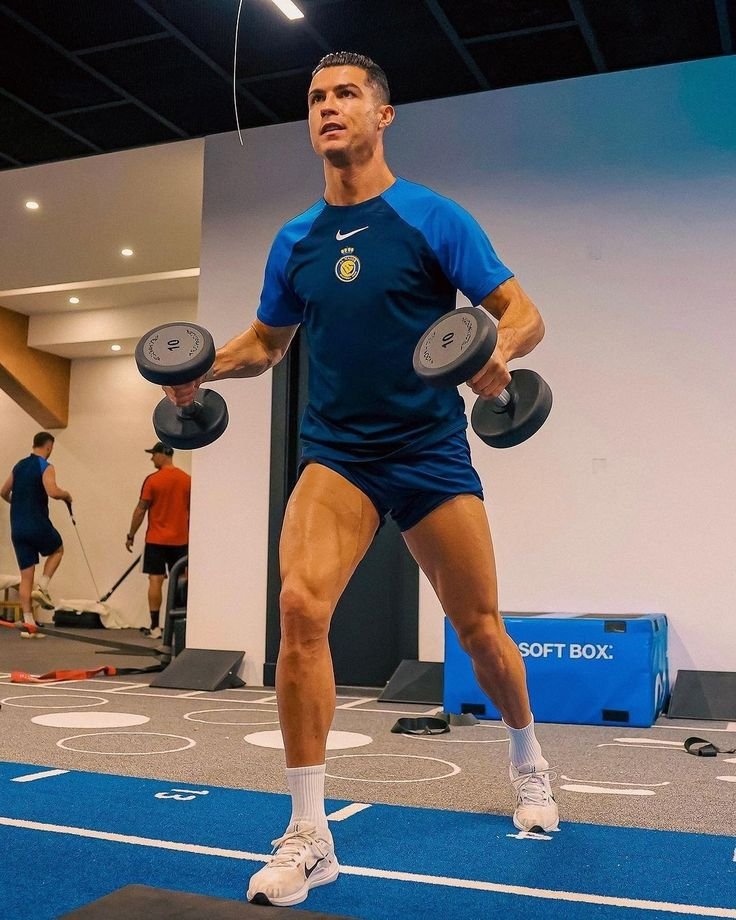
Before breaking down the workouts and meals, it’s worth understanding why Ronaldo’s fitness is considered scientifically remarkable rather than simply impressive for his age.
His Biological Age Shocked Even Him
In 2025, the wearable recovery platform Whoop ran a full physiological analysis on Ronaldo, then 40 years old, and found his biological age to be 28.9 years old, more than a decade younger than his actual age.
Ronaldo himself reacted with disbelief, telling Whoop he now prioritizes recovery and sleep “much more than before,” and joked he could realistically play competitive football for another ten years. This single data point is arguably the single most important proof-point behind the entire Cristiano Ronaldo fitness level conversation; it’s not marketing, it’s measured physiology.
Body Composition: Leaner Than Most Sprinters
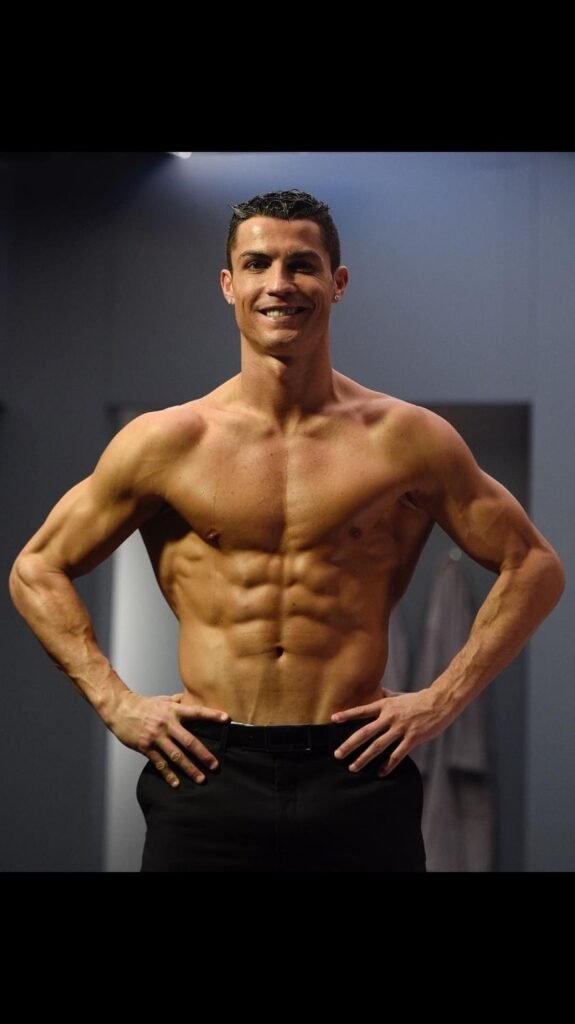
Ronaldo’s body fat sits at approximately 7% lower than the 10–11% average for elite footballers, and comparable to Olympic-level sprinters. His muscle mass is estimated at roughly 50% of total body weight, against an average footballer’s ratio that’s typically several percentage points lower. At 1.87m (6’2″) and around 83–85 kg, Cristiano Ronaldo’s weight has barely fluctuated in over a decade, a sign of extraordinarily disciplined body-composition management rather than natural genetics alone.
| Metric | Cristiano Ronaldo | Elite Footballer Average |
|---|---|---|
| Body fat % | ~7% | 10–11% |
| Muscle mass % | ~50% | 42–46% |
| Resting heart rate | ~50–55 bpm | 60–70 bpm |
| Top sprint speed | 33.6–33.98 km/h | 28–31 km/h |
| Vertical jump | ~44 inches (78 cm reach) | 24–28 inches |
A Career Built on Longevity, Not Just Talent
By the 2026–27 season, Ronaldo sat on 976 career goals (830 for club, 146 for Portugal) just 24 shy of becoming the first player in football history to reach 1,000 official goals. That kind of output at 41 is not just about technique; it’s a direct product of his fitness infrastructure.
Even as Al-Nassr has begun carefully managing his match minutes, substituting him earlier in games since early 2026 to preserve his conditioning for international duty, his per-90-minute output has remained elite, which sports scientists point to as evidence of superior recovery capacity rather than declining ability.
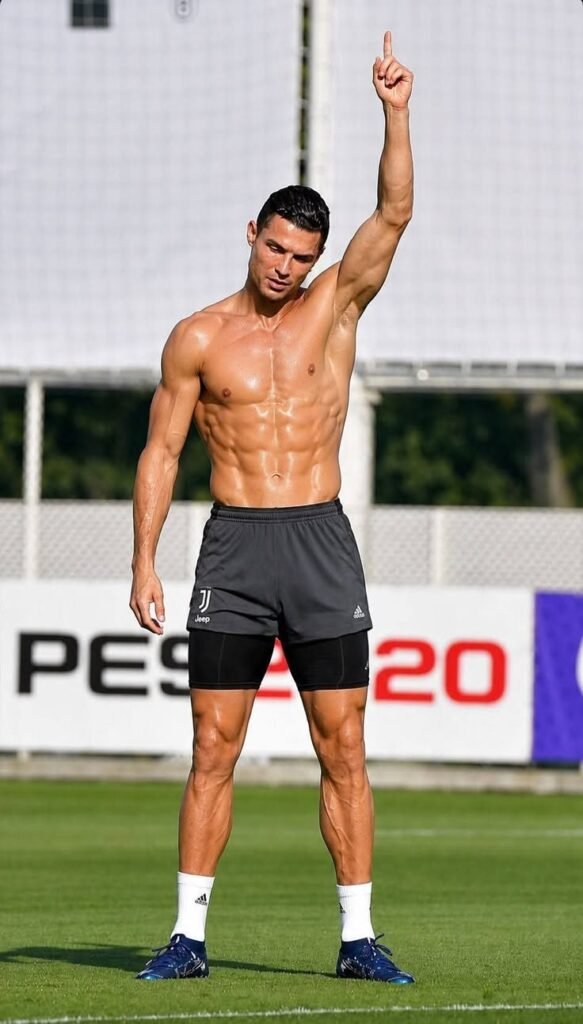
2. Cristiano Ronaldo Workout Routine: Inside His Weekly Training Split
The Cristiano Ronaldo workout routine is built around a principle most amateur lifters ignore: football-specific conditioning always outranks pure aesthetics. Every session is designed to serve explosiveness, durability, and match-day output; the physique is a byproduct, not the goal.
Strength Training: 3–4 Sessions Per Week
Ronaldo’s gym work is centered on compound, functional lifts rather than isolation bodybuilding moves: squats, deadlifts, lunges, and single-leg work that translate directly to sprinting and jumping power. Sessions are typically 45–60 minutes, kept short and intense rather than long and exhausting, since match-day freshness always takes priority over gym fatigue.
Plyometrics and Explosive Power Work
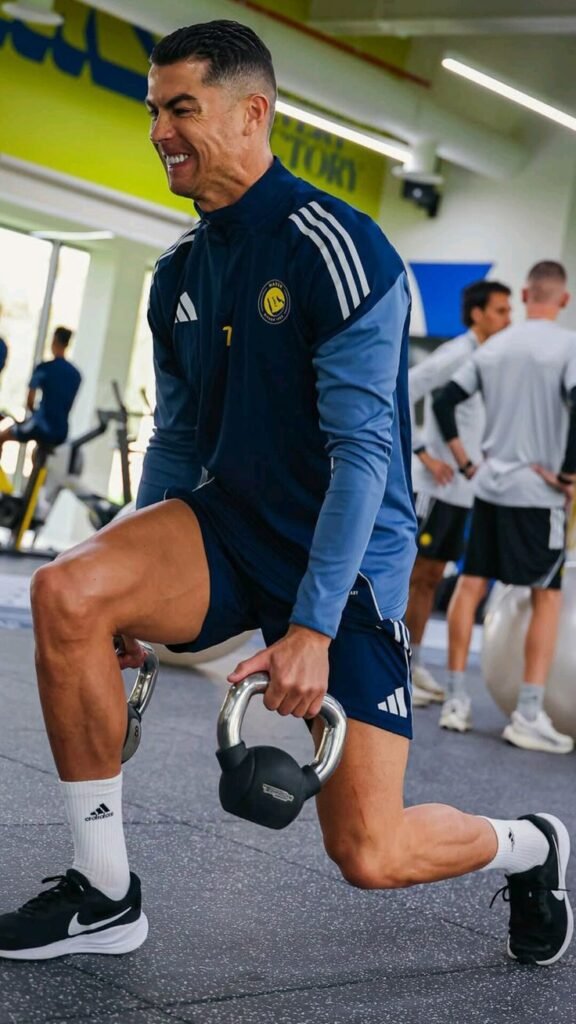
A hallmark of his program is plyometric training: box jumps, resisted sprints, bounding drills, and reactive agility ladders. This is the training block most directly responsible for his sprint acceleration and his ability to out-jump defenders significantly taller than him, a skill on full display in his trademark aerial headers.
Core and Stability Circuits
Ronaldo trains his core almost daily in some form, not for aesthetics but because a strong core underpins balance during physical duels, shooting power, and injury prevention. (Full breakdown in the Cristiano Ronaldo abs workout section below.)
Cardiovascular Conditioning
Rather than long steady-state cardio, Ronaldo’s conditioning work is built around high-intensity interval training (HIIT) and repeated sprint efforts with short recovery windows that mimic the stop-start demands of a 90-minute match far more accurately than jogging ever could.
| Training Component | Frequency | Primary Goal |
|---|---|---|
| Strength/resistance training | 3–4x/week | Power, injury resilience |
| Plyometrics | 2–3x/week | Explosiveness, jump height |
| Core/stability circuits | 5–6x/week | Balance, shot power, injury prevention |
| HIIT/sprint conditioning | 3x/week | Match-speed endurance |
| Technical/ball work | Daily | Skill retention, touch |
| Active recovery (pool, mobility) | 2–3x/week | Regeneration |
3. Cristiano Ronaldo Diet: What He Eats to Fuel an Elite Body
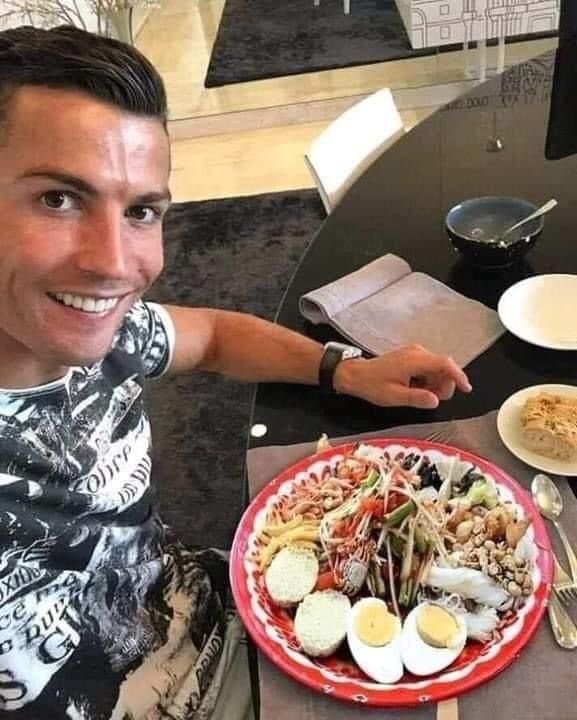
No breakdown of Cristiano Ronaldo fitness is complete without his nutrition system, which is arguably as disciplined as his training.
Six Small Meals, Not Three Large Ones
Rather than the traditional breakfast-lunch-dinner structure, Ronaldo reportedly eats five to six smaller meals spaced throughout the day. This nutrient-timing approach keeps blood sugar stable, supports constant muscle repair, and avoids the energy crashes that come with large, infrequent meals critical for someone training or playing almost daily.
Lean Protein and Complex Carbohydrates
His plates are built around lean proteins (chicken, fish, egg whites), complex carbohydrates (whole grains, sweet potato, oats), and vegetables, with healthy fats from olive oil, nuts, and avocado. Red meat and fried food are largely absent from his diet.
Zero Tolerance for Sugar and Alcohol
Ronaldo is famously strict about cutting refined sugar, soda, and alcohol almost entirely. This isn’t a short-term “diet”; it’s a permanent lifestyle standard he’s maintained for roughly two decades, which nutritionists cite as a bigger long-term driver of his leanness than any single meal plan.
Hydration as a Non-Negotiable

Reports from those close to his camp describe an almost obsessive approach to hydration, with water intake tracked throughout the day; dehydration is one of the fastest ways to lose sprint speed and reaction time, both of which are central to his game.
Sample Daily Meal Structure
| Meal | Typical Composition |
|---|---|
| Meal 1 (early) | Egg whites, oats, fresh fruit |
| Meal 2 (mid-morning) | Grilled chicken breast, brown rice, vegetables |
| Meal 3 (lunch) | Baked fish, sweet potato, salad, olive oil |
| Meal 4 (afternoon) | Protein shake, nuts, fruit |
| Meal 5 (dinner) | Lean protein, quinoa or wholegrain carbs, greens |
| Meal 6 (optional, post-training) | Light protein snack, herbal tea |
![Healthy grilled chicken, vegetables and sweet potato meal representing Cristiano Ronaldo diet plan]](https://famousmagazines.com/wp-content/uploads/2026/09/Cristiano-Ronaldo-diet-plan.jpg)
4. Cristiano Ronaldo Training Schedule: A Day in the Life of CR7
Understanding the Cristiano Ronaldo training schedule means understanding that his day is structured almost entirely around performance windows; waking, training, eating, and sleeping all serve one purpose.
The CR7 Morning Routine
Ronaldo reportedly wakes early, hydrates immediately, and begins with light mobility and activation work before any high-intensity training, a habit borrowed from elite sprinting programs designed to reduce soft-tissue injury risk.
Technical and Tactical Work
Beyond physical conditioning, a significant part of his training schedule is dedicated to technical repetition, first-touch drills, finishing practice, and set-piece work alongside video analysis of upcoming opponents, a habit teammates have described as almost fanatical.
eFootball, Simulation, and Tactical Study
The “Ronaldo training efootball” search trend often refers to how modern footballers, including Ronaldo, use video game simulations and match-data software as tactical study tools, reviewing positional data and opponent tendencies in the same way esports athletes review replays. It’s a reminder that elite performance today blends physical training with data-driven preparation.
Pre-Match Routine
On match days, the Cristiano Ronaldo workout before a match shifts entirely toward activation rather than fatigue dynamic stretching, short sprint bursts, and a carefully timed pre-match meal roughly 3 hours before kickoff, followed by his well-documented habit of applying on-field intensity from the first whistle, driven by an activation routine rather than a heavy training load.
How Many Hours Does Ronaldo Train?
On a typical non-match day, Ronaldo trains for roughly 3 to 4 hours total, split across a team session (60–90 minutes), individual gym/conditioning work (45–60 minutes), and technical or recovery work.
As a teenager at Sporting CP, he reportedly trained considerably longer, often exceeding what his peers were doing, which coaches and biographers alike credit as a foundational habit for his current standards.
5. Cristiano Ronaldo Recovery Routine: Sleep, Naps, and Regeneration Tech

If there’s one area where Ronaldo has publicly said his mindset changed the most, it’s recovery. The Cristiano Ronaldo recovery routine is now considered as important to his longevity as anything he does in the gym.
The Ronaldo Sleep Routine
Ronaldo has spoken about following a polyphasic-influenced sleep structure roughly 8 hours at night supplemented by strategic short naps throughout the day, a method popularized among elite athletes for improving reaction time and reducing cumulative fatigue across a long season.
This Ronaldo sleep routine is frequently cited by performance coaches as one of the most replicable habits from his entire program, since it requires no equipment, just discipline.
Cryotherapy and Contrast Therapy
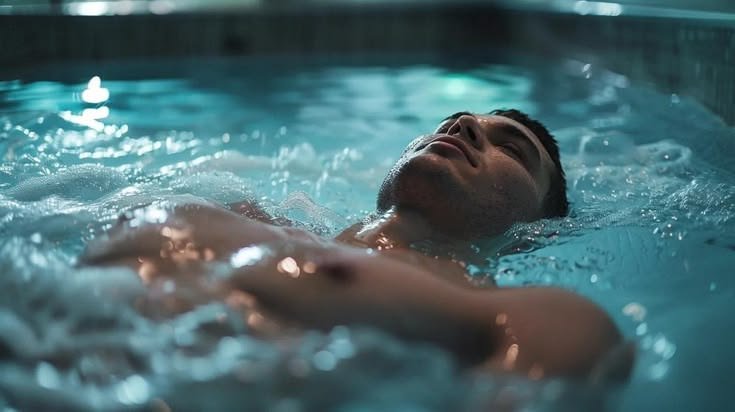
His recovery toolkit reportedly includes cryotherapy chambers, ice baths, and contrast water therapy, all aimed at reducing inflammation and accelerating muscle repair between intense sessions tools now standard across top-tier academies but pioneered at scale by athletes like Ronaldo years earlier.
Wearable-Guided Recovery
His partnership and testing with Whoop reflects a broader shift: Ronaldo doesn’t just “rest”; he measures recovery heart rate variability, sleep quality, and strain scores, all of which inform whether a training day is pushed harder or scaled back, a data-driven approach that directly contributed to the 28.9 biological age finding.
Mental Recovery and Stress Management
Recovery isn’t purely physical. Ronaldo has spoken about meditation-adjacent routines, family time, and deliberate digital disconnection as part of managing the mental load of two decades at the top of a global sport.
6. Cristiano Ronaldo Abs Workout and Leg Workout: Building the Physique

These are the two most-searched physique elements of Cristiano Ronaldo fitness, and for good reason: his six-pack and explosive legs are the visible proof of his training system.
Cristiano Ronaldo Abs Workout
His core training isn’t built around endless crunches. It emphasizes anti-rotation and stability, since a footballer’s core has to resist twisting forces during duels, not just flex forward.
- Hanging leg raises: 4 sets of 10–15 reps
- Planks and side planks : 3 sets, 45–60 second holds
- Cable woodchoppers : 3 sets of 12 reps per side
- Russian twists (weighted) : 3 sets of 20 reps
- Bicycle crunches : 3 sets of 20 reps
Cristiano Ronaldo Leg Workout
Leg training is arguably the single biggest contributor to his shooting power and sprint speed.
- Back squats — 4 sets of 6–8 reps (strength/power focus)
- Bulgarian split squats — 3 sets of 10 reps per leg (unilateral strength)
- Romanian deadlifts — 4 sets of 8 reps (hamstring/posterior chain)
- Box jumps — 4 sets of 8 reps (explosive power)
- Resisted sprint drills — 6–8 reps of 20–30m (acceleration)
- Calf raises — 4 sets of 15 reps (ankle stiffness for sprinting/jumping)
Why This Combination Works
The pairing of heavy strength work with explosive plyometrics is what sports scientists call complex training; it teaches the nervous system to convert raw strength into speed, which is precisely why Ronaldo can still out-jump and out-sprint players a decade younger.
7. Cristiano Ronaldo Speed and Power: The Science Behind His Explosiveness
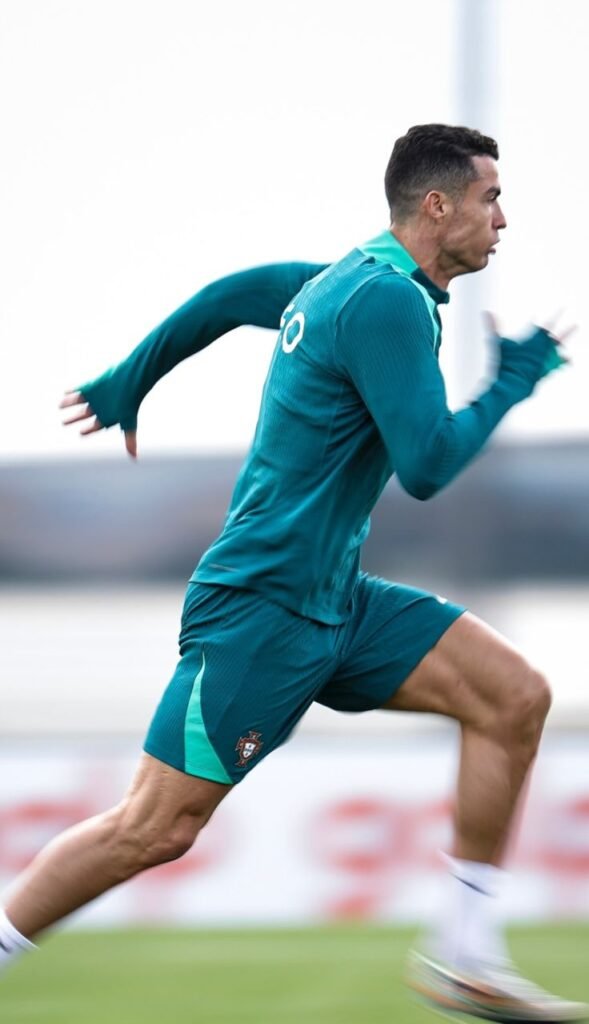
Ronaldo Speed Test and Ronaldo Speed km/h
Ronaldo’s most frequently cited top speed came at the 2018 World Cup against Spain, where he was recorded hitting 33.6–33.98 km/h, making him the fastest player in that tournament at the time.
For context, Kylian Mbappé has been clocked as high as 35.67–38 km/h and Lionel Messi around 32.5 km/h, meaning Ronaldo, despite his size and age relative to those comparisons, remains firmly in the elite bracket rather than trailing behind.
How Fast Can Ronaldo Kick a Soccer Ball?
Ronaldo’s shot power has been measured in various broadcast and lab tests at speeds exceeding 130 km/h (roughly 80 mph) on his hardest strikes among the hardest shots ever measured in professional football, a direct product of his leg workout and core rotational strength working together.
“Ronaldo Tested to the Limit”
Broadcast features and lab-style athlete tests often branded around phrases like “Ronaldo tested to the limit” have repeatedly measured his vertical jump (reported around 44 inches / 78cm reach height), reaction time, and repeated-sprint ability, consistently placing him above average benchmarks even for athletes 10–15 years younger.
Fitness Bands and Tracking Technology
The “ronaldo fitness band” search trend reflects growing public interest in the wearable trackers (like Whoop) that Ronaldo and his club’s sports science team use to monitor heart rate variability, strain, and sleep the same category of consumer fitness bands now available to everyday users wanting to train “smarter, not just harder.”
8. Can You Train Like Ronaldo? Adapting His Fitness Secrets at Home
You don’t need a private training facility to apply the principles behind Cristiano Ronaldo’s fitness secrets. Here’s a realistic, adaptable version.
Cristiano Ronaldo Workout at Home: A Bodyweight-Friendly Version
- Warm-up: 5 minutes dynamic stretching + jumping jacks
- Circuit (3 rounds): 20 bodyweight squats, 15 push-ups, 30-second plank, 15 lunges per leg, 20 mountain climbers
- Core finisher: 3 sets of bicycle crunches + leg raises
- Cool-down: 5–10 minutes static stretching
Realistic Expectations
Ronaldo’s program is the product of 20+ years of professional-grade coaching, nutrition science, and recovery technology most people will never access. Adapting his workout doesn’t mean replicating his results; it means borrowing the principles: consistency, sleep discipline, minimal sugar, and training that mixes strength with explosive movement.
Three Habits Anyone Can Steal Immediately
- Prioritize sleep like a training session, not an afterthought.
- Train explosively, not just heavy; add jumps or sprints to a normal gym routine.
- Cut liquid sugar and alcohol first the single highest-leverage dietary change.
9. Cristiano Ronaldo Fitness vs. Other Elite Athletes: A Comparison

| Athlete | Age (2026) | Body Fat % | Top Speed | Notable Recovery Habit |
|---|---|---|---|---|
| Cristiano Ronaldo | 41 | ~7% | 33.6–33.98 km/h | Whoop-tracked sleep, cryotherapy |
| Lionel Messi | 39 | ~9–10% | ~32.5 km/h | Diet overhaul (anti-inflammatory), family-first schedule |
| Kylian Mbappé | 27 | ~8–9% | 35.67–38 km/h | Sprint-specific conditioning |
| Average Pro Footballer | — | 10–11% | 28–31 km/h | Standard club recovery protocols |
The takeaway isn’t that Ronaldo is biologically superior to everyone on this list; Mbappé, for instance, remains faster in a straight line.
The takeaway is that Ronaldo, at an age where nearly every peer has retired, is still performing within touching distance of athletes over a decade younger, which is the entire reason his fitness system has become a global case study.
FAQ: (Ronaldo Fitness)
How does Ronaldo stay so fit?
Ronaldo stays fit through a combination of strength and plyometric training, a low-sugar, protein-focused diet eaten in small, frequent meals, and an obsessive recovery routine including 8+ hours of sleep, naps, and cryotherapy. Consistency across two decades matters more than any single habit.
How many hours a day did Ronaldo train?
On a typical non-match day, Ronaldo trains roughly 3–4 hours total, combining team sessions, individual gym work, and technical practice. This is supplemented by recovery sessions that, while not “training,” take up additional time daily.
How many hours a day did Ronaldo train as a kid?
As a youth player at Sporting CP, Ronaldo reportedly trained significantly beyond his scheduled team sessions, often adding extra solo practice before and after official training — a habit former coaches and teammates frequently cite as foundational to his current discipline.
Can we adapt Cristiano Ronaldo’s workout?
Yes, in principle. A bodyweight version emphasizing squats, core stability, and explosive movements can be done at home. However, his full program relies on professional coaching, nutrition science, and recovery technology that aren’t fully replicable outside elite sport.
How many push-ups can Ronaldo do?
Ronaldo hasn’t published an official push-up max, but he’s been filmed performing high-rep bodyweight sets (100+ in viral training clips) as part of core and upper-body conditioning circuits, reflecting elite muscular endurance rather than pure one-rep strength.
What is Ronaldo’s biological/physiological age?
A 2025 Whoop analysis measured Ronaldo’s physiological age at 28.9, over a decade younger than his actual age at the time (40), attributed largely to his sleep and recovery discipline.
What does “Ronaldo training eFootball” refer to?
It typically refers to how modern players, including Ronaldo, use video/data simulation tools alongside physical training to study tactics, opponent patterns, and positioning — a blend of physical and data-driven preparation increasingly common in top-tier football.
How fast can Ronaldo kick a soccer ball?
Ronaldo’s hardest recorded shots have exceeded 130 km/h (around 80 mph) in broadcast and testing measurements, among the fastest strikes measured in professional football, driven by his leg strength and core rotational power.
Conclusion
Cristiano Ronaldo fitness at 41 isn’t a fluke it’s the compounding result of a strength-and-power workout routine, a disciplined diet, a data-tracked recovery routine, and a training schedule built around performance rather than aesthetics.
Three takeaways stand out:
First, his 7% body fat and 28.9 physiological age prove recovery matters as much as training volume;
Second, explosive plyometric work, not just heavy lifting, is what preserves his elite speed and jump height;
Third, none of it works without ruthless consistency across decades, not weeks.
You won’t replicate a professional athlete’s entire infrastructure, but the principles prioritizing sleep, training explosively, and cutting sugar are available to anyone starting today. Try the home workout adaptation above for two weeks and track how your energy, not just your physique, changes.
Fact-checked as of September 2026. Figures such as body fat percentage, sprint speed, and biological age are drawn from publicly reported testing (including Whoop analysis) and broadcast/lab measurements, and may vary slightly across sources and testing conditions.



Post Comment