How to Make Exercise a Habit : 9 Proven Tips
Learn how to make exercise a habit with 9 practical tips to stay consistent, build a workout routine, and improve your fitness.
What if you could make exercise a regular part of your life without depending on motivation every day? The secret is to build a routine that fits your schedule, energy levels, and personal goals rather than forcing yourself into an unrealistic workout plan.
Learning how to make exercise a habit is not just about working harder. It involves habit formation, practical planning, and small actions that become easier to repeat over time. Whether you are a beginner, a busy professional, a student, or someone returning to fitness after a long break, you can develop an exercise routine that works for your lifestyle.
The challenge is familiar: you start with enthusiasm, exercise consistently for a few days, and then work, fatigue, family responsibilities, or a missed workout disrupts your progress. Fortunately, you do not need perfect discipline to overcome this cycle. You need a sustainable system.
In this guide, you’ll learn nine practical ways to build an exercise habit, how to stay consistent with exercise, how to develop a fitness routine, and what to do when motivation disappears.
You’ll also discover a simple seven-day starter plan, common mistakes to avoid, and strategies for making physical activity a lasting part of your daily life.
Why Is It Hard to Exercise Consistently?
Starting an exercise program is often easier than maintaining one. Initial enthusiasm can encourage you to make ambitious plans, but long-term consistency depends on how well those plans fit your everyday life.
Understanding the barriers that interrupt exercise adherence the ability to maintain a physical activity routine is the first step toward building better habits.
1. Depending on motivation alone
Motivation naturally fluctuates. You may feel excited about exercising after watching a fitness video or setting a new goal, but that enthusiasm can fade when you are tired, busy, or stressed.
Waiting until you feel motivated creates an unpredictable routine. Instead, connect exercise to a specific time or existing activity. For example, take a 10-minute walk after lunch rather than deciding each day whether you feel like walking.
A reliable schedule reduces the number of decisions you must make before starting.
2. Setting unrealistic fitness goals
Beginning with an intense daily workout can leave you sore, exhausted, or discouraged. If your initial plan requires too much time or effort, it may become difficult to maintain.
For example, someone who has not exercised recently might plan to visit the gym for an hour every day. A more realistic starting point could be three short sessions per week, gradually increasing as fitness improves.
Realistic goals make it easier to experience progress without turning exercise into another source of pressure.
3. Treating exercise as an extra responsibility
Busy schedules can make exercise feel like a task that competes with work, studying, household responsibilities, and social commitments.
The solution is to integrate movement into your existing routine. You could walk while taking a phone call, cycle to a nearby destination when practical, or complete a short workout before beginning your evening activities.
4. Expecting immediate results
Improvements in strength, endurance, and physical confidence take time. When people judge their progress only by visible changes in their bodies, they may overlook early improvements in energy, mood, mobility, and performance.
Track behaviors you can control, such as the number of workouts completed or the minutes spent walking. These measures provide useful feedback while longer-term fitness improvements develop.
9 Ways to Make Exercise a Habit
The most effective approach is to make exercise manageable, predictable, and rewarding. These nine strategies can help you develop a routine that suits your current fitness level and schedule.
1. Start with small, achievable workouts
One of the simplest ways to build an exercise habit is to begin with a manageable amount of activity.
If you are a beginner, try a short walk, gentle mobility exercises, or a brief bodyweight session. You can increase the duration or intensity gradually as your confidence and fitness improve.
A small starting goal is useful because it reduces the effort required to begin.
For example:
-
Walk for 10 minutes after breakfast.
-
Perform a short mobility routine before work.
-
Complete a few comfortable sets of beginner strength exercises.
-
Take the stairs when it is practical and safe.
The purpose of these initial sessions is not to achieve maximum fitness immediately. It is to establish a repeatable pattern.
Practical tip: Set a minimum version of your workout. On busy days, you might aim for five minutes of movement instead of skipping the activity entirely. If you have enough time and energy, you can continue longer.
A short session is a useful fallback, not a replacement for all the activity needed to meet your long-term health goals.
2. Schedule exercise at a consistent time
A workout becomes easier to remember when it has a defined place in your day.
Instead of writing “exercise more” on your to-do list, choose a specific time and activity. For example, schedule a walk at 7:30 a.m. on Monday, Wednesday, and Friday.
Your ideal time depends on your schedule, sleep, energy, and preferences. Morning exercise works well for some people, while others prefer exercising after work or school.
The key is to select a time you can realistically maintain.
Try this simple planning formula:
When + where + what activity
Example: “On Tuesday and Thursday, I will walk around my neighborhood for 15 minutes after work.”
This approach turns a vague intention into a concrete action.
![A weekly planner with scheduled walking, strength training, and stretching sessions]](https://famousmagazines.com/wp-content/uploads/2026/10/A-weekly-planner-576x1024.png)
3. Connect exercise to an existing habit
Habit stacking means attaching a new behavior to something you already do regularly.
Because established routines are easier to remember, linking exercise to a familiar activity can help make it part of your daily life.
Examples include:
-
After brushing your teeth, perform a short mobility routine.
-
After lunch, take a brisk walk.
-
After finishing work, change into workout clothes.
-
After preparing your morning coffee, do a few minutes of gentle movement.
Choose a routine that happens reliably. If your lunch time changes every day, for example, connecting exercise to a consistent evening activity may work better.
Start with one connection and repeat it regularly before adding more.
Habit stacking does not guarantee that a behavior will become automatic, but it creates a predictable cue that can make starting easier.
4. Choose exercises you genuinely enjoy

You are more likely to maintain an activity when you find it satisfying, comfortable, or enjoyable.
You do not need to follow the most popular workout trend. Some people enjoy strength training, while others prefer dancing, cycling, swimming, yoga, walking, or recreational sports.
Experiment with different activities and notice which ones you look forward to repeating.
Consider these options:
| Activity | Why you might enjoy it | Suitable starting approach |
|---|---|---|
| Walking | Accessible and easy to fit into a day | Begin with a comfortable short walk |
| Dancing | Music adds enjoyment and variety | Try a few favorite songs |
| Strength training | Offers measurable progress | Start with basic, manageable movements |
| Cycling | Combines movement with outdoor exploration | Choose a safe, easy route |
| Yoga | Combines movement, balance, and flexibility | Follow a beginner-friendly session |
| Swimming | Provides whole-body movement with low impact | Begin at a comfortable pace if you can swim safely |
The best exercise routine is not necessarily the most demanding one. It is one that fits your needs and that you can repeat safely.
5. Set realistic and measurable fitness goals
A useful fitness goal tells you exactly what action you intend to take and how you will track it.
Broad goals such as “get fit” can feel overwhelming because they do not explain what to do today. Specific goals create a clearer path forward.
For example:
-
Walk for 15 minutes three times this week.
-
Complete two beginner strength sessions this week.
-
Take a short movement break during each long study session.
-
Gradually increase walking time when the current duration feels comfortable.
You can also use the SMART goals framework. Goals should be specific, measurable, achievable, relevant, and time-bound.
For example, “I will walk for 15 minutes after lunch on Monday, Wednesday, and Friday for the next two weeks” is more actionable than “I will exercise more.”
Review your goals weekly. If they are too difficult to maintain, adjust them instead of abandoning your entire routine.
6. Prepare your workout environment in advance
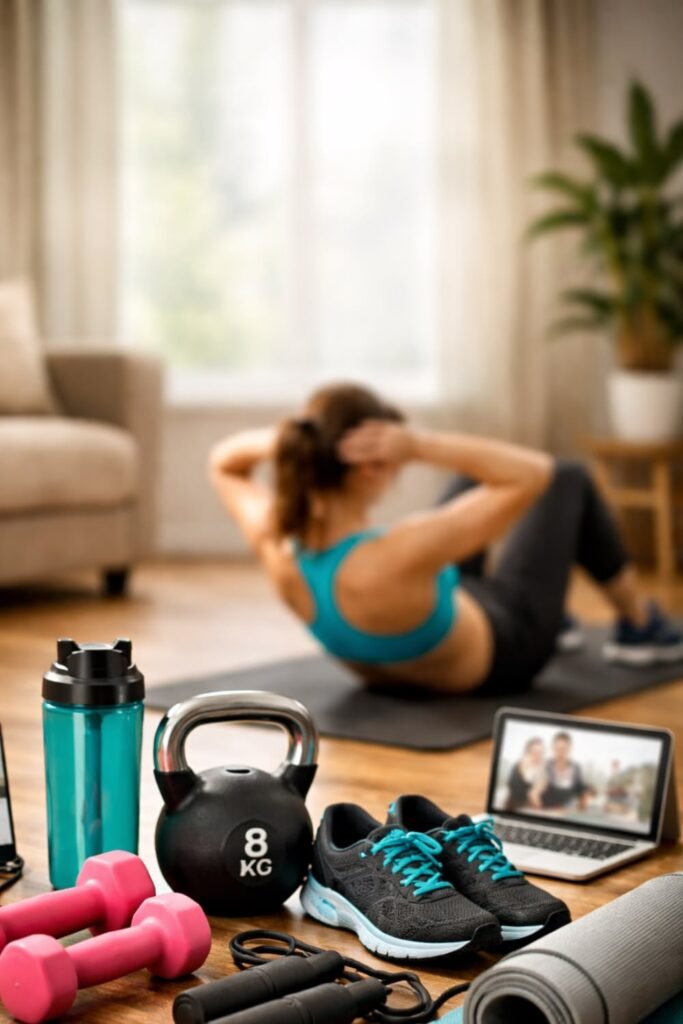
Small obstacles can make exercise easier to postpone. Searching for your shoes, deciding what to wear, or finding a workout video may create unnecessary friction.
Prepare what you need before your planned session.
You can:
-
Place your walking shoes near the door.
-
Set out comfortable workout clothing.
-
Prepare a water bottle.
-
Choose your workout video in advance.
-
Keep basic exercise equipment in a convenient location.
If you exercise at home, designate a small area where you can move safely without obstacles.
If you prefer the gym, pack your bag the night before.
These steps reduce the number of decisions required to get started. They will not remove every barrier, but they can make following through more convenient.
7. Track your progress without becoming obsessed with results
Progress tracking helps you see whether your routine is becoming more consistent.
You do not need expensive equipment or a complicated fitness application. A calendar, notebook, or simple spreadsheet can be enough.
Record details such as:
-
Whether you completed the planned session.
-
How long you exercised.
-
Which activity you performed.
-
How difficult the session felt.
-
Any gradual improvements in duration, strength, or endurance.
Focus on your actions rather than judging every session as a success or failure.
For instance, completing three planned walks in a week is meaningful progress even if you do not notice immediate physical changes.
Wearable devices and fitness apps can provide additional information, but they are optional. Choose a tracking method that encourages consistency without creating anxiety or unnecessary pressure.
8. Find an accountability partner
An accountability partner can help you follow through by providing encouragement, companionship, or a shared commitment.
This could be a friend, family member, colleague, or workout partner who has similar goals.
You might arrange two weekly walks, share your planned sessions, or check in with each other every Sunday.
Keep the arrangement supportive rather than competitive. Comparing your progress with someone else’s can be discouraging when your schedules, abilities, and starting points differ.
If you prefer exercising alone, accountability can still come from a calendar reminder, a workout log, or a recurring appointment with yourself.
The goal is to create a structure that makes your commitment easier to remember.
9. Focus on consistency, not perfection
Missing a workout does not erase your previous effort. What matters is how you respond to interruptions.
People often fall into an all-or-nothing pattern: if they cannot complete the planned session, they decide that the entire day is a failure.
A more useful approach is to adapt.
If you planned a 30-minute workout but have only 10 minutes available, do a shorter session if appropriate. If you are sick, injured, or unusually exhausted, rest or choose suitable gentle movement instead.
Try the following recovery plan:
-
Identify why the workout was missed.
-
Decide whether the barrier can be prevented next time.
-
Choose the next realistic opportunity to exercise.
-
Return to your normal routine without trying to compensate with an excessive workout.
Consistency means returning to the routine, not performing perfectly every day.
How to Build an Exercise Habit That Lasts
Knowing how to make exercise a habit is useful, but maintaining that habit requires a routine that can adapt to real life.
Create a minimum and a full version of your workout
A flexible routine has two versions: your normal session and a shorter alternative for difficult days.
| Situation | Minimum version | Full version |
|---|---|---|
| Limited time | 5–10 minutes of movement | A planned 20–30-minute session |
| Low motivation | Put on workout clothes and begin gently | Complete the planned routine if you feel able |
| Bad weather | Indoor walking or suitable home exercises | Your usual outdoor activity when conditions permit |
| Busy workday | A short walk or movement break | A longer workout at a scheduled time |
| Feeling unwell | Rest or appropriate gentle activity | Resume normal exercise when recovered |
These are examples, not universal prescriptions. Adapt activities to your health, ability, and circumstances.
A minimum version helps preserve continuity, but it should not become a reason to ignore recovery needs or indefinitely avoid sufficient physical activity.
Use cues and rewards to reinforce the routine
A habit cue is a signal that reminds you to begin an action. It might be a calendar alert, your walking shoes by the door, or the end of your lunch break.
A reward is something satisfying that reinforces the experience. You might enjoy listening to a favorite podcast while walking, appreciating the fresh air, or marking a completed session on your calendar.
Try to choose rewards that support your routine rather than undermine it. The satisfaction of completing an activity can itself be rewarding.
Over time, a reliable cue and a positive experience may make the behavior easier to repeat.
Make your routine flexible enough to survive change
A sustainable exercise habit should work even when your schedule changes.
If you travel, identify a short hotel-room or bodyweight routine. If your work hours shift, choose a different exercise window. If you lose access to a gym, consider walking or home-based activities.
Build flexibility into your plan before problems arise.
This is particularly helpful for students during examinations, parents with changing responsibilities, and professionals with unpredictable workdays.
How to Stay Consistent With Exercise
Consistency improves when you anticipate common obstacles instead of relying on willpower to overcome them every time.
Plan for common barriers
Use an if-then plan to decide what you will do when a predictable obstacle occurs.
| Barrier | Your if-then plan |
|---|---|
| I wake up late | If I miss my morning session, I will walk after lunch if possible |
| I feel unmotivated | If I hesitate to begin, I will try five minutes and reassess |
| It rains | If my outdoor route is unsuitable, I will exercise indoors |
| I have a busy day | If I cannot complete my full workout, I will consider a short alternative |
| I miss a session | If I miss today, I will resume at my next planned opportunity |
These plans reduce the need to make decisions under pressure.
They also make it easier to distinguish between a temporary obstacle and a routine that needs redesigning.
Understand the role of sleep and recovery
Exercise is only one part of a healthy lifestyle. Sleep, nutrition, hydration, and recovery influence how you feel and how well you tolerate physical activity.
If you regularly feel exhausted, consider whether your schedule is too demanding or whether you are allowing enough recovery time.
Avoid increasing workout duration and intensity too quickly. Beginners may benefit from alternating harder sessions with easier activities or rest days.
If you have a medical condition, persistent pain, or concerns about starting exercise, seek advice from a qualified healthcare professional about an appropriate routine.
Follow public health recommendations while progressing gradually
The World Health Organization recommends that adults aim for 150–300 minutes of moderate-intensity aerobic physical activity per week, or an equivalent amount of vigorous activity, along with muscle-strengthening activities on at least two days per week. Some people may need to adapt these recommendations to their abilities and health circumstances.
These recommendations describe a longer-term activity target, not a requirement that every beginner must meet immediately.
Start from your current activity level and increase gradually. Even small amounts of movement are worthwhile when beginning to move more.
Source: World Health Organization — Physical Activity.
A 7-Day Beginner Exercise Plan

The following plan demonstrates how to begin building an exercise habit without attempting an intense workout every day. Adjust it to your fitness level, ability, and schedule.
DAY 01
MON
Start with a short walk
Try 10 minutes at a comfortable pace. Focus on beginning at the planned time rather than covering a particular distance.
DAY 02
TUE
Try gentle mobility exercises
Spend 5–10 minutes on comfortable movements suited to your abilities. Stop if a movement causes pain.
DAY03
WED
Repeat your walk
Repeat Monday’s activity. If it feels comfortable, extend it slightly, but do not feel obliged to increase the duration.
DAY04
THU
Choose enjoyable movement
Try gentle dancing, cycling at an appropriate pace, or another activity you enjoy.
DAY05
FRI
Try beginner strength exercises
If appropriate for you, practice a few comfortable bodyweight movements, focusing on technique rather than intensity.
DAY06
SAT
Repeat your favorite activity
Choose the activity you most enjoyed during the week. Make the session comfortable and achievable.
DAY07
SUN
Review and plan
Reflect on what worked, identify barriers, and schedule next week’s sessions. Take a rest day or choose gentle movement as appropriate.
Your weekly exercise habit tracker
Use this checklist to monitor whether you are establishing a repeatable routine.
Weekly progress
0/7
Check a day when you complete your planned activity. Rest days can count as successful recovery days; the goal is to follow your overall plan, not exercise intensely every day.
Reset tracker
At the end of the week, ask yourself three questions:
-
Which activities were easiest to start?
-
What prevented me from following my plan?
-
What one adjustment would make next week more manageable?
Use your answers to improve the routine rather than judging yourself.
Common Exercise Habit Mistakes
Even a well-designed routine can become difficult to maintain if you approach it with unrealistic expectations.
Doing too much too soon
A demanding schedule may feel exciting initially, but suddenly increasing duration or intensity can lead to excessive fatigue, soreness, or injury.
Begin with activities you can perform comfortably and increase gradually. Allow time for recovery, especially when introducing strength training or more vigorous exercise.
Comparing yourself with other people
Social media often shows carefully selected fitness achievements and dramatic transformations. These examples do not represent everyone’s starting point, schedule, or physical abilities.
Compare your progress with your own previous behavior instead. Walking more comfortably, completing planned sessions, or feeling more confident with an exercise are useful signs of progress.
Treating a missed session as failure
One missed workout is an event, not a permanent setback.
Rather than compensating with a much longer or harder session, return to your next planned workout. If the same problem happens repeatedly, adjust your schedule, activity, or expectations.
Ignoring enjoyment and recovery
A sustainable routine should include activities you like, manageable challenges, and appropriate recovery.
If every session feels unpleasant or exhausting, consider reducing the intensity or trying another activity. Persistent pain, dizziness, chest discomfort, or unusual shortness of breath warrants stopping exercise and seeking appropriate medical assessment; severe or sudden symptoms require urgent care.
FAQs (How to Make Exercise a Habit)
1. How long does it take to make exercise a habit?
There is no universal timeline for making exercise a habit. It depends on the activity, your schedule, the consistency of your routine, and individual differences. Focus on repeating a manageable behavior and making it easier to start rather than expecting automatic habits after a fixed number of days.
2. How can I make exercise a daily habit?
Choose a manageable activity, attach it to an existing routine, and schedule it at a consistent time. Prepare what you need in advance and track your progress. Daily movement does not require intense workouts every day; your routine should also allow for rest and recovery when needed.
3. Why is it so hard to stay consistent with exercise?
Consistency can be difficult when workouts feel too demanding, schedules are unpredictable, or progress seems slow. Starting small, selecting enjoyable activities, and planning for common obstacles can make exercise easier to maintain. If your routine repeatedly fails, redesign it around your real circumstances instead of relying solely on motivation.
4. How can beginners start exercising regularly?
Beginners can start with comfortable activities such as walking, gentle mobility work, or simple strength exercises suited to their abilities. Choose a few realistic sessions each week and increase activity gradually. People with medical concerns or significant physical limitations should consult a qualified healthcare professional before beginning a new exercise program.
5. Is 10 minutes of exercise a day enough?
Ten minutes of exercise is a useful starting point, particularly for someone who is currently inactive. Short sessions can contribute to overall physical activity, although your long-term needs depend on your age, health, activity intensity, and goals. Gradually build toward appropriate public health recommendations as your fitness improves.
6. How do I stay motivated to work out when I feel lazy?
Make starting easier by preparing your clothes, choosing an enjoyable activity, and setting a small minimum goal. Try beginning with five minutes and reassessing how you feel. If you are sick, injured, or genuinely exhausted, rest may be the better choice. Consistency does not mean ignoring your body’s needs.
7. What should I do if I miss a workout?
Resume your routine at the next realistic opportunity. Identify why you missed the session and adjust your plan if necessary. Avoid trying to make up for missed activity with an excessive workout. A flexible routine that accommodates occasional interruptions is generally more sustainable than one that depends on a perfect schedule.
8. What is the easiest way to build an exercise routine?
Start by choosing one activity you enjoy and connecting it to a predictable time or existing habit. Schedule a few manageable sessions, prepare your environment, and track completion. Once the routine feels manageable, increase activity gradually. Simplicity and repeatability are more useful starting points than a complicated workout plan.
9.What is the best workout plan for women over 40?
The best workout plan for women over 40 combines strength training 2–3 days per week, regular walking or other cardio, and stretching or mobility exercises. Beginners should start slowly, allow time for recovery, and gradually increase intensity. Follow our women’s fitness workout plan over 40 for a practical at-home routine, weekly workout schedule, and strength-training tips.
Final Thoughts
Learning how to make exercise a habit starts with a simple principle: create a routine you can realistically repeat. You do not need to transform your schedule overnight or depend on feeling motivated every morning. Small, planned actions can help you establish a foundation for long-term physical activity.
Remember these three takeaways:
-
Start small: Choose manageable workouts and increase activity gradually.
-
Build a system: Use consistent cues, realistic goals, and a plan for busy days.
-
Return without guilt: Missed workouts happen; focus on resuming your routine safely.
Your next step is to choose one activity, schedule your first session, and prepare what you need today. Start where you are, adapt as you learn, and give yourself time to develop a sustainable exercise habit.




Post Comment