Women’s Fitness Over 40: Free At-Home Workout Guide

Get a free women’s fitness workout plan for home or the gym at 30, 40, and 50. Full-body, HIIT, and strength routines are included. Start your plan today.
Women’s fitness after 40 runs on different rules than it did at 25: hormones shift, muscle mass declines by roughly 3–8% per decade after 30, and recovery takes longer.
But here’s the encouraging part: research on 621 women across 31 studies found female lifters can increase strength by more than 7% per week in the upper body and over 5% per week in the lower body with the right fitness training over 40 female plan, no gym membership required.
In this guide, you’ll learn how to build a free women’s fitness workout plan at home, how often to train each muscle group, what a real body transformation after 40 female journey actually looks like, and exactly what to eat to support it.
Whether you’re 30, 40, or 50, everything below is designed to, and every training recommendation is cross-checked against published exercise-science guidance rather than generic fitness-influencer advice, so you can trust the numbers, not just the exercises.
1. Why Women’s Fitness Needs a Different Approach After 30, 40, and 50
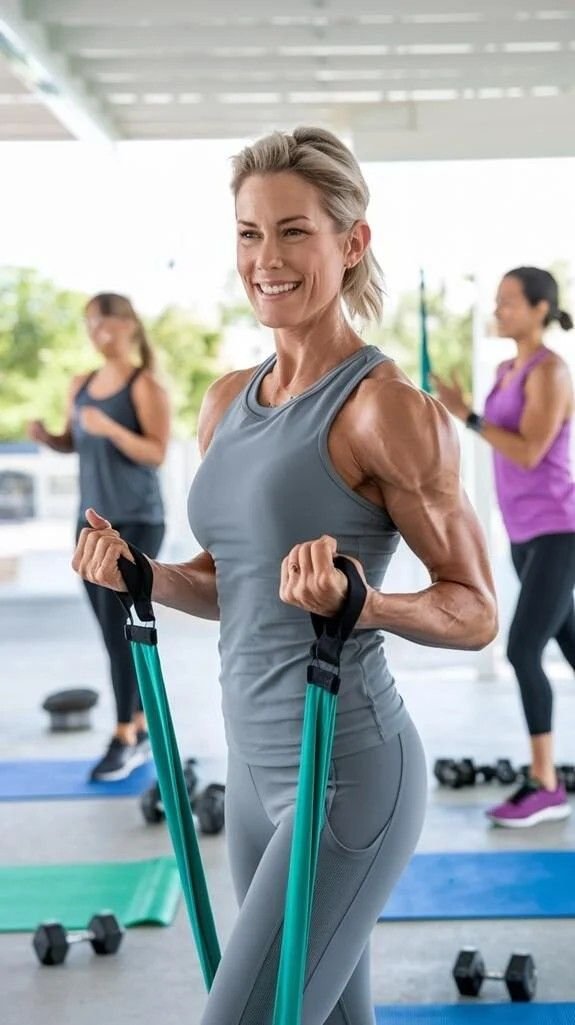
Training in your 40s isn’t a scaled-down version of training in your 20s; it’s a different program built around different physiology. Three factors drive most of that difference: hormones, muscle mass, and bone density. Most generic “women’s fitness” content skips straight to workouts without explaining why the programming changes, which is where a lot of over-40 training plans quietly fail.
How Hormones and the Menstrual Cycle Affect Training at 40
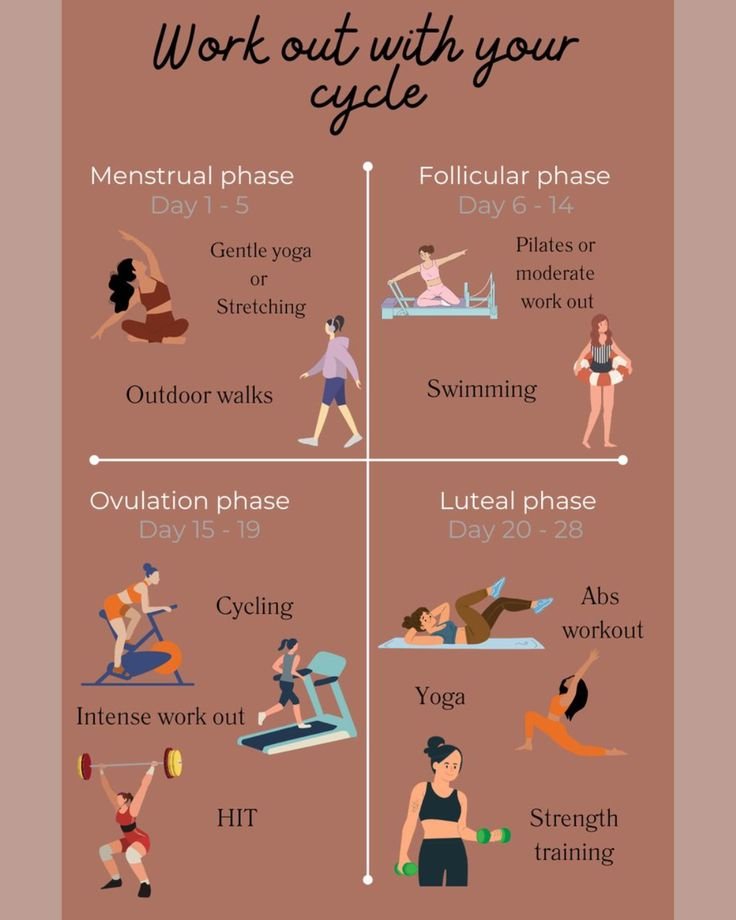
In your 40s, menstrual cycle and hormonal health become a bigger training variable, since perimenopause often begins during this decade and brings less predictable estrogen and progesterone levels.
Estrogen plays a direct role in muscle repair and joint collagen, so as levels fluctuate, recovery time can vary week to week even when training stays identical.
That doesn’t mean training less; it means paying closer attention to energy, sleep, and recovery, and adjusting intensity on lower-energy days rather than pushing through by default.
Muscle Loss, Metabolism, and Body Transformation After 40

Muscle mass naturally declines with age, which slows resting metabolism and makes fat loss feel harder even when diet and activity stay the same.
This is exactly why strength training not just cardio- sits at the center of any real body transformation after 40: preserving and building muscle protects metabolic rate, and with proper strength training, adequate protein intake, and consistent recovery, visible muscle definition is still very achievable in your 40s.
Hormonal changes may slow the pace of visible change slightly, but they don’t put results out of reach; they just mean consistency matters more than intensity spikes.
Bone Density and Exercises for Osteoporosis Prevention
More than a quarter of women over 65 have osteoporosis, and the risk climbs after menopause as estrogen levels drop and bone loss accelerates.
Weight-bearing and resistance exercises squats, lunges, rows, and step-ups are among the most effective, low-cost tools for women’s fitness for osteoporosis prevention, because loading the skeleton is what signals bone to stay dense.
Starting this work in your 30s and 40s, before bone density naturally begins to decline, offers more protection than waiting until after a diagnosis.
Common Training Mistakes Women Make After 40
Three mistakes show up repeatedly in over-40 training: skipping strength work in favor of cardio-only routines (which accelerates muscle loss rather than preventing it), under-eating protein while trying to lose weight (which causes the body to burn muscle instead of fat), and skipping warm-ups (which becomes riskier as joint mobility naturally decreases with age).
Addressing all three matters more than any single “advanced” technique. A fourth, subtler mistake: chasing the same weekly workout total that worked at 25 without adjusting for the longer recovery windows hormonal shifts can require; more isn’t always better once the body is asking for rest.
2. The Best Free Women’s Fitness Workout Plans (Home, Gym, 30s–50s)
You don’t need a paid program to get real results. Below are three free-plan structures built for different settings and life stages, each using the same evidence-based training frequency covered in Section 4.
Free At-Home Workout Plan for Women (No Equipment)

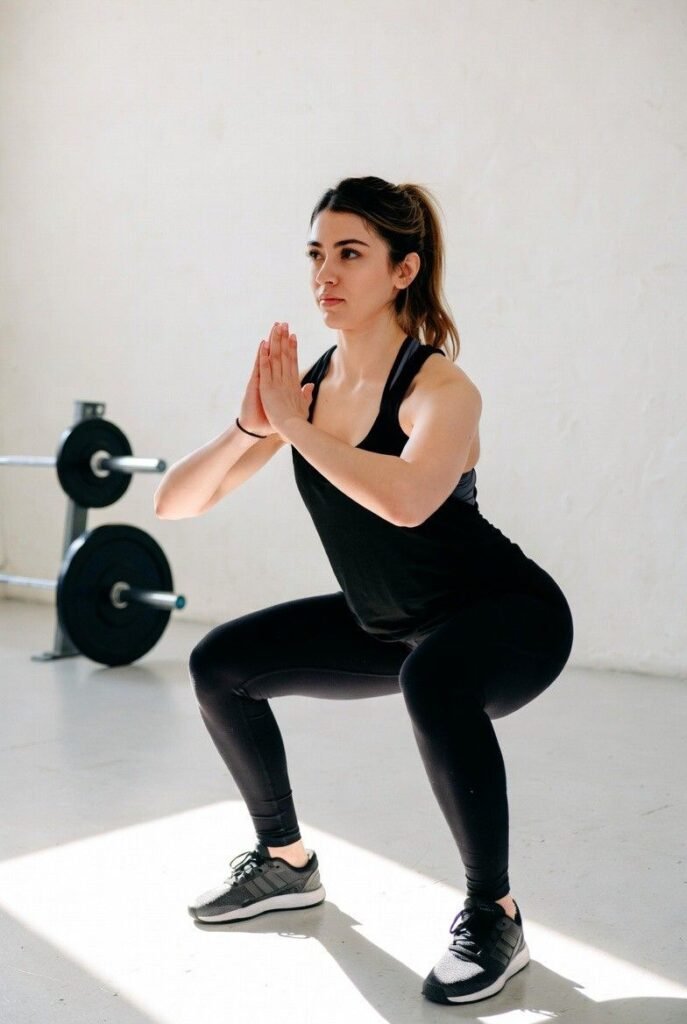
A free women’s fitness workout plan at home should still hit every major movement pattern: push, pull, hinge, squat, and rotation using nothing but bodyweight.
Here’s a full 3-day structure with sets, reps, and rest built in:
| Day | Exercise | Sets x Reps | Rest |
|---|---|---|---|
| Day 1 — Lower Body | Bodyweight squats | 3 x 12–15 | 45–60 sec |
| Glute bridges | 3 x 15 | 45 sec | |
| Reverse lunges (each leg) | 3 x 10 | 45–60 sec | |
| Calf raises | 3 x 15–20 | 30 sec | |
| Day 2 — Upper Body | Push-ups (knee or full) | 3 x 8–12 | 60 sec |
| Tricep dips (off a chair) | 3 x 10–12 | 45 sec | |
| Superman raises | 3 x 12 | 30 sec | |
| Plank rows (household weights) | 3 x 10 each side | 45 sec | |
| Day 3 — Full Body + Core | Squat-to-press | 3 x 10 | 60 sec |
| Mountain climbers | 3 x 30 sec | 30 sec | |
| Bird-dogs | 3 x 10 each side | 30 sec | |
| Side planks | 3 x 20–30 sec each side | 30 sec |
Free Women’s Fitness Workout Plan at the Gym
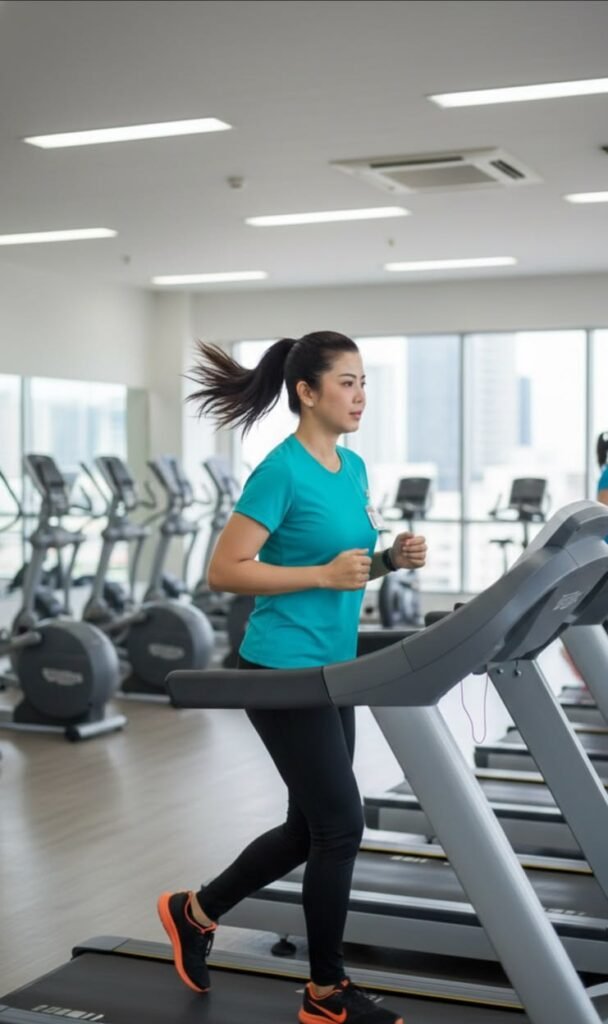
The same structure translates directly to a gym floor once machines and free weights are available: swap bodyweight squats for goblet squats or the leg press, and bodyweight rows for a cable row or lat pulldown.
A free women’s fitness workout plan in a gym setting simply lets you add progressive load faster, which matters most once bodyweight exercises stop feeling challenging.
A reasonable progression rule: once you can complete all sets at the top of a rep range with good form, add 5–10% more load or move to the next exercise variation.
Free Women’s Fitness Workout Plan at 30 vs. 40 vs. 50
The exercises don’t need to change dramatically across decades the dosing does.
| Decade | Weekly Strength Sessions | Focus | Recovery Priority |
|---|---|---|---|
| Free women’s fitness workout plan at 30 | 3–4 | Building strength and muscle base | Standard — 1 rest day between sessions |
| Women’s fitness over 40 | 3–4 | Preserving muscle, protecting joints, managing hormonal shifts | Higher — prioritize sleep and protein timing |
| Free women’s fitness workout plan at 50 | 2–4 | Bone density, balance, and functional strength | Highest — longer warm-ups, more mobility work |
3. Full-Body, Upper-Body, and Lower-Body Workouts for Women
Full-Body Workout for Women (Sample Routine)
A full-body workout for women trains every major muscle group in one session and works well 2–3 times a week for beginners or anyone with limited training days. A balanced session covers one push, one pull, one hinge, one squat, and one core movement:
- Push-ups — 3 x 8–12
- Bent-over rows — 3 x 10–12
- Hip hinges (glute bridges or Romanian deadlifts) — 3 x 12
- Goblet squats — 3 x 10–12
- Plank hold — 3 x 30–45 sec
Upper-Body Workout for Women
An upper-body workout for women should balance pushing movements (push-ups, shoulder presses) with pulling movements (rows, band pull-apart) at roughly a 1:1 ratio, since most daily posture already skews toward the chest and shoulders; extra pulling work helps counteract that.
A sample split: shoulder press (3 x 10), rows (3 x 12), chest press (3 x 10), band pull-apart (3 x 15), bicep curls (2 x 12), triceps extensions (2 x 12).
Lower-Body Workout for Women
A lower-body workout built around squats, lunges, hip hinges, and glute bridges directly supports the bone-density goals covered in Section 1, since the legs and hips carry the body’s largest weight-bearing bones. Sample structure: squats (4 x 10), Romanian deadlifts (3 x 12), walking lunges (3 x 12 each leg), hip thrusts (3 x 15), calf raises (3 x 20).
4. Push-Pull-Legs vs. Full-Body: Which Women’s Workout Routine Wins?
What Is a Push-Pull-Legs Workout for Women?

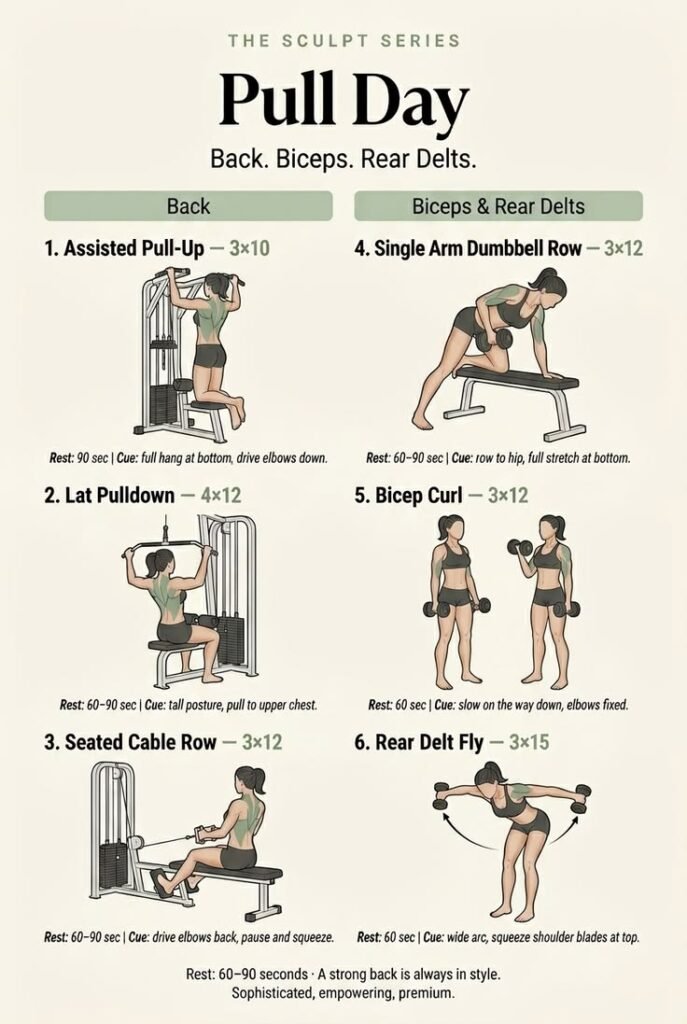
A push-pull-legs workout splits training into three distinct sessions: push (chest, shoulders, triceps), pull (back, biceps), and legs (quads, hamstrings, glutes), repeated across a week. It suits women training 4–6 days a week who want more volume per muscle group than a full-body split allows in a single session.
The trade-off is time: a push-pull-legs schedule demands more weekly training days than a full-body plan, so it fits better once consistency with 3 sessions a week is already established rather than as a starting point for a complete beginner.
Sample Push-Pull-Legs Split for Women (Weekly Layout)
| Day | Focus | Key Exercises |
|---|---|---|
| Monday | Push | Push-ups, shoulder press, triceps dips |
| Tuesday | Pull | Rows, lat pulldown, bicep curls |
| Wednesday | Legs | Squats, Romanian deadlifts, calf raises |
| Thursday | Rest or light cardio | Walking, mobility work |
| Friday | Push | Chest press, lateral raises, overhead extensions |
| Saturday | Pull | Deadlifts, face pulls, hammer curls |
| Sunday | Legs or rest | Lunges, glute bridges, hip thrusts (or full rest) |
How Often Should Women Train Each Muscle Group?
The American College of Sports Medicine recommends women strength train each major muscle group 2–3 times per week, and research analyzing 621 female subjects across 31 studies found the lower body responds best to training twice weekly, while the upper body can handle two to three sessions per week for optimal strength gains.
That’s the real answer behind “women fitness: how often to train each muscle”: twice weekly per muscle group is the evidence-backed floor, not once. Most competing guides stop at “2–3 times a week” without distinguishing upper- from lower-body recovery needs, which is a meaningful gap this data closes.
| Routine | Sessions/Week | Best For | Equipment Needed |
|---|---|---|---|
| Full-body | 2–3 | Beginners, limited time, home training | None to minimal |
| Upper/Lower split | 4 | Intermediate lifters wanting more volume | Dumbbells recommended |
| Push-Pull-Legs | 3–6 | Advanced lifters, muscle-building focus | Gym or full home rack |
Together, these make up the core women’s workout routine options, and any of them can function as a women’s muscle-building workout as long as the training volume and protein intake (covered in Section 6) support recovery.
5. HIIT Workouts, Cardio, and Training Around Your Cycle
Best HIIT Workout for Women (15–20 Minutes)
A HIIT workout for women pairs 30–40 seconds of high effort with 20–30 seconds of rest, repeated for 4–6 rounds. It’s an efficient way to build cardiovascular fitness without extending the weekly time commitment, and it requires no equipment. Sample 18-minute circuit (repeat 4 rounds):
- Jump squats: 40 sec on / 20 sec rest
- Mountain climbers: 40 sec on / 20 sec rest
- High knees: 40 sec on / 20 sec rest
- Push-up to plank jack:40 sec on / 20 sec rest
- Rest 60 sec between full rounds
Exercising on Your Period: What to Know
Exercising on your period is generally safe and, for many women, helps ease cramping and mood symptoms the main adjustment is intensity, not avoidance. On lower-energy days, swapping heavy strength work or HIIT for walking, mobility, or a lighter full-body session respects the hormonal dip without derailing the weekly plan.
Tracking energy levels against your cycle for a couple of months (a fitness tracker, covered in Section 7, makes this easier) helps identify your personal pattern rather than relying on generic advice.
6. Nutrition for Women’s Fitness After 40
How Much Protein Does a Woman Need in Her 40s?
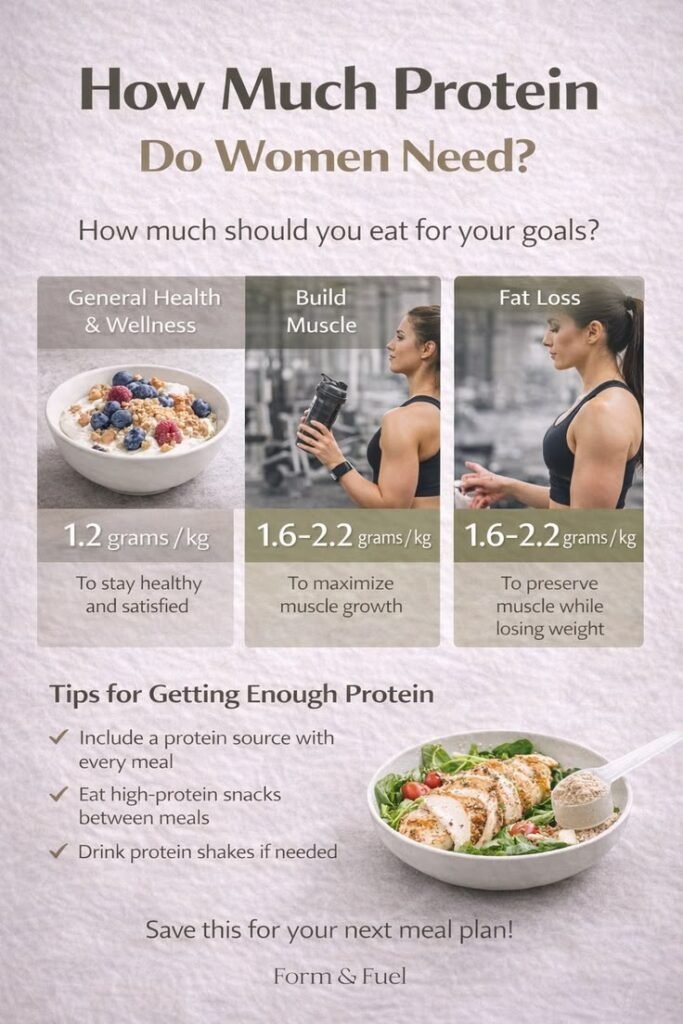
To answer “how much protein does a woman need at 40s” directly: most guidance lands between 1.2 and 2.0 grams of protein per kilogram of body weight per day, with the higher end of that range better supporting muscle preservation during strength training.
For a 68 kg (150 lb) woman, that’s roughly 82–136 grams daily, noticeably higher than the general population’s baseline recommendation, which is a distinction many generic nutrition articles miss.
High-Protein Meals for Women’s Fitness Goals
Practical high-protein meals for women’s fitness goals include:
| Meal | Example | Approx. Protein |
|---|---|---|
| Breakfast | Greek yogurt, berries, protein powder | 30–35g |
| Lunch | Grilled chicken or tofu grain bowl | 35–40g |
| Snack | Cottage cheese with vegetables | 15–20g |
| Dinner | Salmon or lentils with quinoa and greens | 30–35g |
Hydration and Sleep: The Overlooked Multipliers
Protein gets most of the attention in women’s fitness nutrition content, but hydration and sleep quietly determine whether that protein actually gets used to build and repair muscle.
Dehydration as small as 2% of body weight measurably reduces strength output and endurance, and poor sleep raises cortisol, which works directly against fat loss and muscle repair.
A practical target: half your body weight in ounces of water daily, and 7–9 hours of sleep, treated as non-negotiable as the workouts themselves, not an afterthought once training and eating are “handled.”
Putting It All Together: A Sample Weekly Schedule
With training frequency, HIIT, and recovery all covered separately above, here’s how a woman over 40 following a full-body approach might structure an entire week:
| Day | Session | Duration |
|---|---|---|
| Monday | Full-body strength (Section 3) | 35–45 min |
| Tuesday | Walking or light mobility | 20–30 min |
| Wednesday | Full-body strength or HIIT circuit (Section 5) | 30–40 min |
| Thursday | Rest or gentle yoga | — |
| Friday | Full-body strength (Section 3) | 35–45 min |
| Saturday | HIIT circuit (Section 5) or outdoor cardio | 20–30 min |
| Sunday | Full rest | — |
This layout delivers three strength sessions and one to two cardio sessions per week, enough to meet the twice-weekly-per-muscle-group threshold from Section 4 while leaving two full rest days for hormone-sensitive recovery.
Women following the push-pull-legs structure from Section 4 instead would swap the three strength days above for the six-day PPL layout, with Sunday remaining a full rest day either way.
7. Gear That Actually Helps: Trackers, Equipment, and the Right Bra
Best Fitness Trackers for Women
Among current fitness tracker for women options, priorities differ by goal:
| Tracker | Best For | Strength |
|---|---|---|
| Garmin (Venu / Forerunner lines) | Running and detailed training metrics | Precise GPS, long battery life |
| Oura Ring | Discreet, all-day comfort | Sleep and recovery insights, no screen needed |
| Fitbit (Charge / Air lines) | Everyday health tracking on a budget | Simple interface, lowest price point |
| Whoop | Athletic performance and strain tracking | Recovery and training-load analytics |
Choosing Between These Trackers
The right pick depends on what you’re actually trying to solve. If cycle-aware training (Section 5) is the priority, a ring-style tracker with strong sleep and recovery insights, like Oura, fits better than a sports watch built primarily for GPS.
If running or structured cardio is the main goal, Garmin’s training-load metrics offer more actionable detail. And if the goal is simply consistency, steps, basic heart rate, a nudge to move, a budget Fitbit does the job without the extra cost of subscription-based recovery scoring.
Gym Equipment for Women’s Fitness at Home
A minimal but effective gym equipment setup for women’s fitness includes one set of adjustable dumbbells, a resistance band, and a yoga mat enough to progress every routine in this guide well beyond what bodyweight alone can offer.
Best Gym Bra for High-Impact Workouts
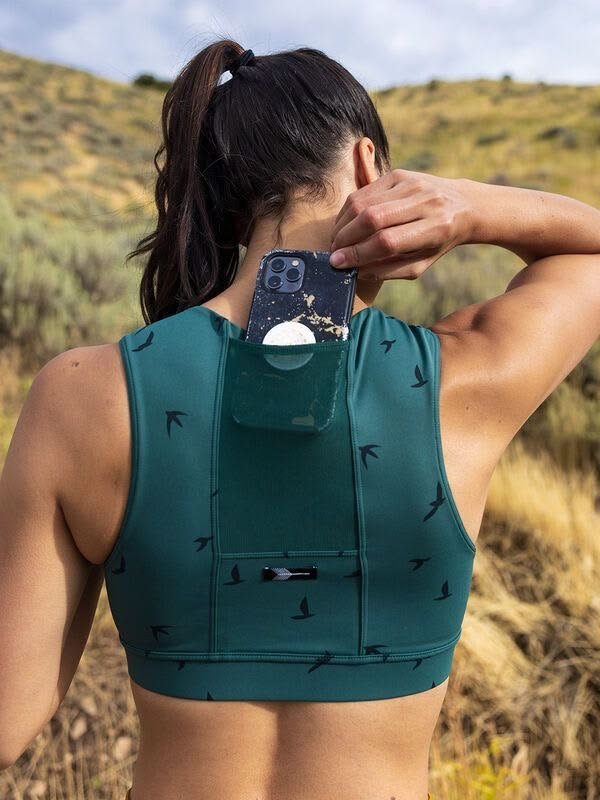
For HIIT, running, or plyometric work, the best gym bra for high-impact workouts uses an encapsulation-and-compression design rather than compression alone, since that combination controls movement more effectively during high-bounce activity.
Fit matters more than brand: a properly sized band and cup outperforms a premium bra in the wrong size.
8. How to Warm Up and Cool Down Safely After 40
Warm-up and cool-down protocols matter more with age, since joint mobility and tissue elasticity both decrease over time, raising injury risk if training starts cold. Most competing women’s fitness guides mention “warm up first” without specifying what that actually looks like; here’s a complete protocol.
Dynamic Warm-Up (5–8 Minutes, Before Every Session)
- Arm circles: 30 sec each direction
- Bodyweight squats (slow tempo): 10 reps
- Walking lunges with a twist: 8 reps each side
- Cat-cow spinal stretch: 8 reps
- Hip circles: 10 each direction
This sequence raises core temperature, lubricates joints, and activates the muscle groups about to be trained all of which reduce strain-related injury risk during the main workout.
Cool-Down and Recovery (5–10 Minutes, After Every Session)
A brief static stretch routine hamstring stretch, quad stretch, chest opener, and child’s pose– each held 20–30 seconds, helps muscles return to resting length and supports the next day’s mobility.
Pairing this with the sauna or cold-plunge recovery methods mentioned in Section 6’s broader nutrition-and-recovery context can further reduce next-day soreness, particularly after heavier lower-body sessions.
Signs You Need to Modify a Workout
Sharp joint pain (as opposed to normal muscle fatigue), dizziness, or unusual shortness of breath are signals to stop and modify, not push through. Swapping a high-impact move for a low-impact version (jump squats to regular squats, for example) preserves the training effect while respecting joint limits, which matters more with age than any single “perfect” exercise choice.
9. Setting Realistic Women’s Fitness Goals at 40
How to Set Women’s Fitness Goals at 40
Effective women’s fitness goals at 40 are built around behavior, not just the scale. Training consistency, protein intake, sleep, and strength benchmarks (like the number of full push-ups completed) tend to predict long-term success better than a target weight alone.
What a Realistic 12-Week Transformation Looks Like
Most transformation content built for a general audience sets timeline expectations that don’t account for the slower recovery and hormonal variability covered in Section 1, which is why so many women over 40 feel like a program “isn’t working” at week 3, when in reality the visible-change timeline simply runs longer.
A grounded body transformation after 40 female timeline, based on the training frequency and nutrition targets above:
- Weeks 1–4: Form improves, workouts feel easier at the same load, energy and sleep often improve first; visible body composition change is usually minimal.
- Weeks 5–8: Strength increases become measurable (heavier weights, more reps at the same effort); clothes may fit differently before the scale moves much.
- Weeks 9–12: Visible muscle definition typically becomes noticeable, particularly in the arms, shoulders, and legs, assuming consistent training and protein intake throughout.
Women’s Fitness Influencers to Follow for Motivation
Following women fitness influencers who train at a similar life stage, including postpartum athletes, women documenting strength training in their 40s and 50s, and coaches specializing in perimenopause training, provides more realistic, sustainable motivation than generic fitness content aimed at a 20-something audience.
10. How This Free Plan Compares to Popular Paid Programs
Several paid programs on the market, including 8-week beginner strength guides sold for roughly $20–25 and subscription-based coaching apps, cover largely the same structure outlined in this guide: progressive bodyweight or light-dumbbell strength training, 3–4 sessions a week, built around low-impact, joint-friendly movements for women over 40.
| Feature | This Free Plan | Typical Paid Program |
|---|---|---|
| Cost | $0 | $20–50 one-time, or monthly subscription |
| Training structure | Full-body, upper/lower, and PPL options included | Usually one fixed structure |
| Nutrition guidance | Protein targets and meal examples included | Often sold as a separate add-on |
| Progress tracking | Manual or via a fitness tracker (Section 7) | Often includes a branded tracking app |
| Customization | Adjust sets/reps and split freely | Fixed weekly structure |
The main advantage of a paid program is built-in accountability (reminders, progress logs, community), something you can replicate for free with a habit tracker, a shared calendar with a workout partner, or a fitness-tracker app from Section 7.
For most beginners, the free structure in this guide covers everything a $20–50 program would, and the money saved is better spent on one solid piece of equipment, like an adjustable dumbbell set, than on program access alone.
What Free Programs Get Right (and What They Miss)
Free women’s fitness content generally does a good job covering individual workouts a HIIT circuit here, a lower-body routine there but most stop short of explaining how those pieces fit into a full week, how training frequency should differ between upper and lower body, or how nutrition targets shift specifically for women over 40.
That gap is exactly what Sections 4 and 6 of this guide are built to close: not just “what to do,” but how often and how much.
4-Week Progression Plan for Beginners
Progressive overload, gradually increasing difficulty, is what separates a workout that produces results from one that plateaus. A simple 4-week ramp for any of the routines above:
| Week | Sets per Exercise | Rep Target | Rest Between Sets |
|---|---|---|---|
| Week 1 | 2 | Lower end of range | 60 sec |
| Week 2 | 3 | Lower–mid range | 60 sec |
| Week 3 | 3 | Mid–upper range | 45 sec |
| Week 4 | 3–4 | Upper end of range, or add light load | 45 sec |
By week 4, most beginners are ready to either add external weight (dumbbells, a resistance band) or progress to a more advanced routine, such as the upper/lower split or push-pull-legs structure covered in Section 4.
FAQ (Women’s Fitness At Home)

The questions below cover the details that come up most often once someone actually starts one of the plans above: equipment, frequency, protein, and hormones.
Can women over 40 build strength with just bodyweight or light dumbbells at home?
Yes. Bodyweight and light-dumbbell training builds real strength when volume and consistency are there. Start with resistance bands or light weights, focus on form, and progress load or reps every 1–2 weeks as movements get easier.
How many days a week should a woman over 40 work out at home?
Three to five days works for most women over 40: three full-body sessions is a solid starting point, while four to five days suits those focused on muscle building or weight management, provided at least one full rest day is included weekly.
Do I need equipment, or can I get results with a no-equipment routine?
No equipment is required. Bodyweight-only programs — squats, push-ups, lunges, planks — produce measurable strength and fat-loss results, though adding dumbbells or bands later helps sustain progress once bodyweight exercises become easy.
What should a weekly workout split look like for a beginner over 40?
A beginner-friendly split trains full-body 3 days a week (e.g., Monday, Wednesday, Friday), covering push, pull, squat, and hinge movements each session, with rest or light walking on the days in between to support recovery.
How much protein do women over 40 need to support strength training?
Most guidance recommends 1.2–2.0 grams of protein per kilogram of body weight daily. For a 68 kg woman, that’s roughly 82–136 grams a day, spread across meals to support muscle repair and preserve lean mass during strength training.
Will hormonal changes after 40 make it harder to see results?
Hormonal shifts can slow progress slightly, but they don’t prevent results. Consistent strength training, adequate protein, and quality sleep still produce visible muscle definition and fat loss; recovery just plays a bigger role than it did in your 20s.
Can I really get in shape after 40 without a gym membership?
Yes. Strength training, preserved muscle mass, and a faster resting metabolism are all achievable through structured at-home programs using bodyweight or minimal equipment. A gym membership speeds progression but isn’t required to get started.
Is it safe to exercise during your period?
Generally, yes. Moderate exercise during menstruation is safe and can even ease cramps and mood symptoms. Scale intensity down on low-energy days by swapping heavy strength work for walking or mobility rather than skipping training entirely.
Key Takeaways
Three things matter most for women’s fitness at any age past 30: strength training at least twice weekly per muscle group, protein intake in the 1.2–2.0 g/kg range, and recovery habits that scale up as hormones shift through the 40s and 50s. None of it requires a gym membership to start a free, consistent bodyweight plan builds the same foundation a paid program does.
Pick one of the splits above, commit to three sessions this week, and adjust from there based on how your body responds.
This guide draws on published exercise-science research (including a 31-study analysis of resistance training outcomes in women), guidance from the American College of Sports Medicine, and current market data on wearables and training programs, current as of 2026. It is intended for general fitness education and is not a substitute for individualized advice from a physician, physical therapist, or certified trainer — particularly for anyone managing an existing injury, chronic condition, or high-risk pregnancy.


Post Comment