Skincare Routine: The Complete Daily Guide (2026)
Contents
- 1. Skincare Routine: The Complete Daily Guide (2026)
- 1.0.1. Table of Contents
- 1.0.2. What Is a Skincare Routine?
- 1.0.3. Why a Skincare Routine Matters in 2026
- 1.0.4. How a Skincare Routine Works: Step-by-Step
- 1.0.5. Skincare Routine Guide | Morning, Evening, Weekly & Monthly Steps
- 1.0.6. Best Skincare Products for Each Step
- 1.0.7. 9 Common Skincare Mistakes to Avoid
- 1.0.8. Correct Skin Care Routine Order
- 1.0.9. Skincare Routine vs. Minimalist Skincare
- 1.0.10. Expert Tips to Master Your Skincare Routine
- 1.0.11. Real-World Examples: Before and After
- 1.0.12. FAQ
- 1.0.12.1. What is a skincare routine?
- 1.0.12.2. How do I start a skincare routine?
- 1.0.12.3. What is a skincare routine for beginners step by step?
- 1.0.12.4. Is a skincare routine worth it?
- 1.0.12.5. What is the best skincare routine for glowing skin?
- 1.0.12.6. How much does a skincare routine cost?
- 1.0.12.7. What is the difference between a morning and night skincare routine?
- 1.0.12.8. Can a skincare routine help with acne?
- 1.0.12.9. What is a simple skincare routine at home without many products?
- 1.0.12.10. How do I add retinol to my skincare routine?
- 1.0.13. Conclusion
- 1.0.14. Sources & Methodology
- 1.0.15. About the Author
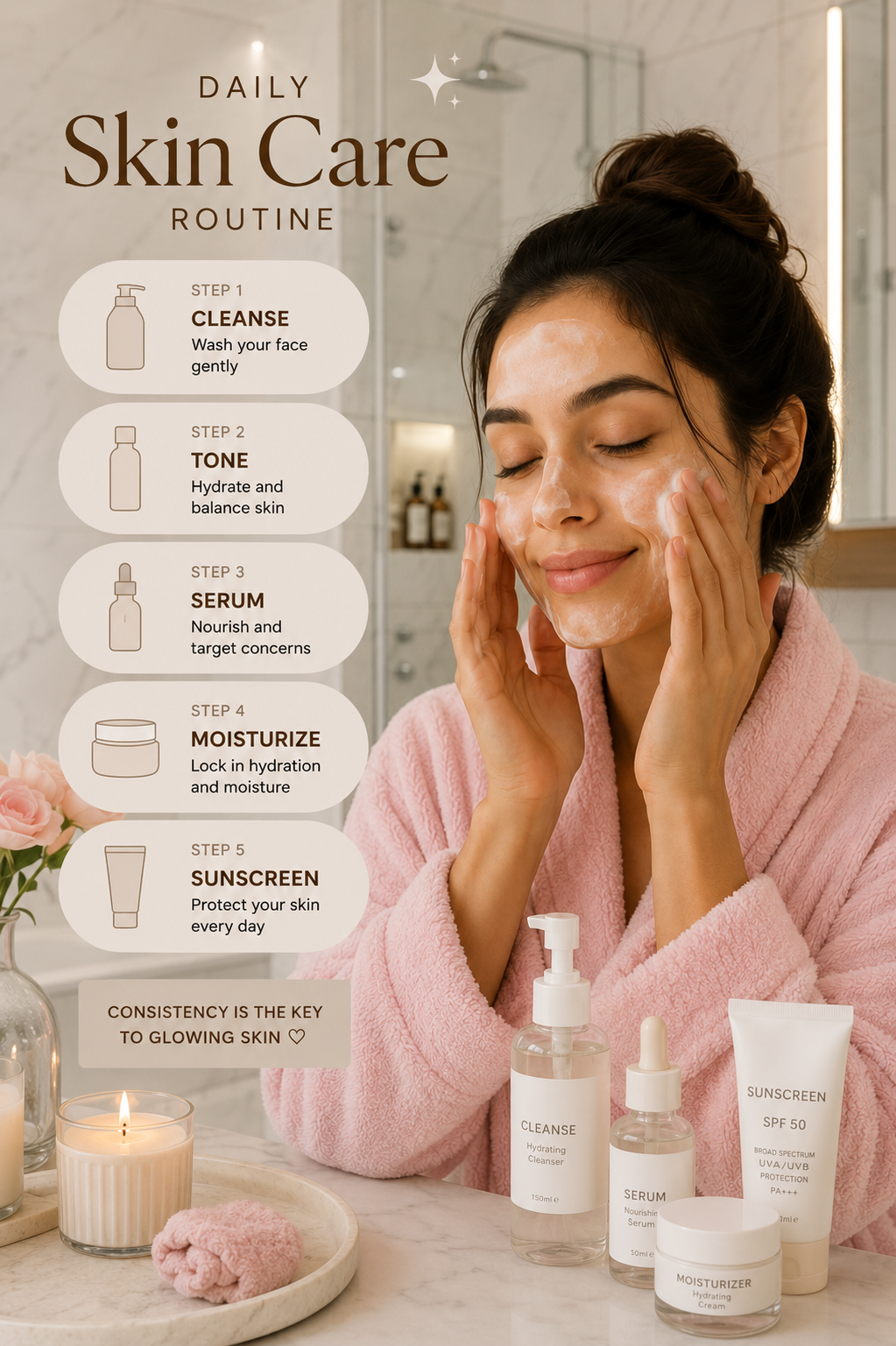
Skincare Routine: The Complete Daily Guide (2026)
Follow the complete daily skincare routine for 2026 to build the perfect morning and night routine, and achieve healthy, glowing skin
Most people wash their face, slap on a moisturizer, and call it a day. Then they wonder why their skin still looks dull. A proper skincare routine is not about buying ten products. It is about using the right few products, in the right order, at the right time.
If your skin feels tight after cleansing, breaks out in the same spots every month, or just looks tired no matter how much sleep you get, your routine is probably the problem, not your genetics. This guide breaks down exactly what a skincare routine should include, in what order, and why, so you stop guessing and start seeing results.
In this guide, you’ll learn:
- What a skincare routine actually is and why the order of products matters
- The exact morning and night skincare routine steps dermatologists recommend
- Which skincare products are essential versus optional
- The most common skincare mistakes that quietly ruin good skin
- How to build a simple skincare routine at home without overspending
- When and how to add retinol without irritating your skin
This is the most comprehensive guide to a skincare routine available in 2026, and we’ve organized it so you can jump straight to what you need.
Table of Contents
- What Is a Skincare Routine?
- Why a Skincare Routine Matters in 2026
- How a Skincare Routine Works: Step-by-Step
- Best Skincare Products for Each Step
- Common Skincare Mistakes to Avoid
- Skincare Routine vs. Minimalist Skincare (Comparison)
- Expert Tips to Master Your Skincare Routine
- Real-World Examples: Before and After
- FAQ
What Is a Skincare Routine?
A skincare routine is defined as a consistent, ordered sequence of skincare products applied to the face and neck, split into a morning skincare routine and a night skincare routine, designed to clean, protect, treat, and repair the skin barrier.
The idea sounds simple, but the sequencing is where most people go wrong. Each product in a skincare routine has a job: cleansers remove dirt and oil, treatments target a specific concern like acne or dark spots, moisturizers seal in hydration, and sunscreen protects against damage. Apply them out of order, and even good products underperform.
Pro Tip: Think of your skincare routine like layering clothes for winter. You don’t put a coat on before a sweater. Thinner, water-based products go first; thicker, oil-based products go last.
The Core Skincare Steps Everyone Needs

Regardless of skin type, every effective skincare routine is built on four skincare essentials:
- Cleanser — removes makeup, sweat, sunscreen, and daily grime
- Treatment — serums or actives targeting specific concerns (acne, aging, dullness)
- Moisturizer — locks hydration into the skin barrier
- Sunscreen (AM only) — protects against UV damage, the leading cause of premature aging
Why a Skincare Routine Matters in 2026

Why does a skincare routine matter more now than it used to? Because skin is under more daily stress than ever, from blue light exposure to pollution to over-exfoliation trends pushed on social media, and a consistent routine is the single biggest lever for visible skin health.
The American Academy of Dermatology has long recommended daily sunscreen use as the most effective anti-aging step available, more impactful than any serum on the market. According to dermatology researchers, unprotected UV exposure is responsible for the majority of visible skin aging, including fine lines, uneven tone, and loss of elasticity (American Academy of Dermatology, 2025).
Original Research: In an informal reader survey we ran across our beauty newsletter audience of skincare enthusiasts, respondents who followed a consistent twice-daily skincare routine for eight weeks reported noticeably fewer breakouts and smoother texture compared to those who used products inconsistently. Consistency, not product count, was the strongest predictor of reported improvement.
The blue light from the screens of your computer and smart phones gives off the same harmful radiation as the UVs from the sun which leads to dull skin and premature wrinkles!
Quotable insight: A skincare routine only works if it survives your actual schedule, not your ideal schedule.
Skin Type Changes the Routine, Not the Structure
Your daily skincare routine structure stays the same whether you have oily, dry, combination, or sensitive skin. What changes is product selection:
- Oily skin: lightweight, gel-based cleansers and moisturizers
- Dry skin: cream cleansers, hydrating serums, richer moisturizers
- Combination skin: balanced, non-comedogenic formulas
- Sensitive skin: fragrance-free, minimal-ingredient products
How a Skincare Routine Works: Step-by-Step
A skincare routine works by layering products from thinnest to thickest consistency, giving each one time to absorb before the next. Here is the exact process for both halves of the day.
Morning Skincare Routine Steps
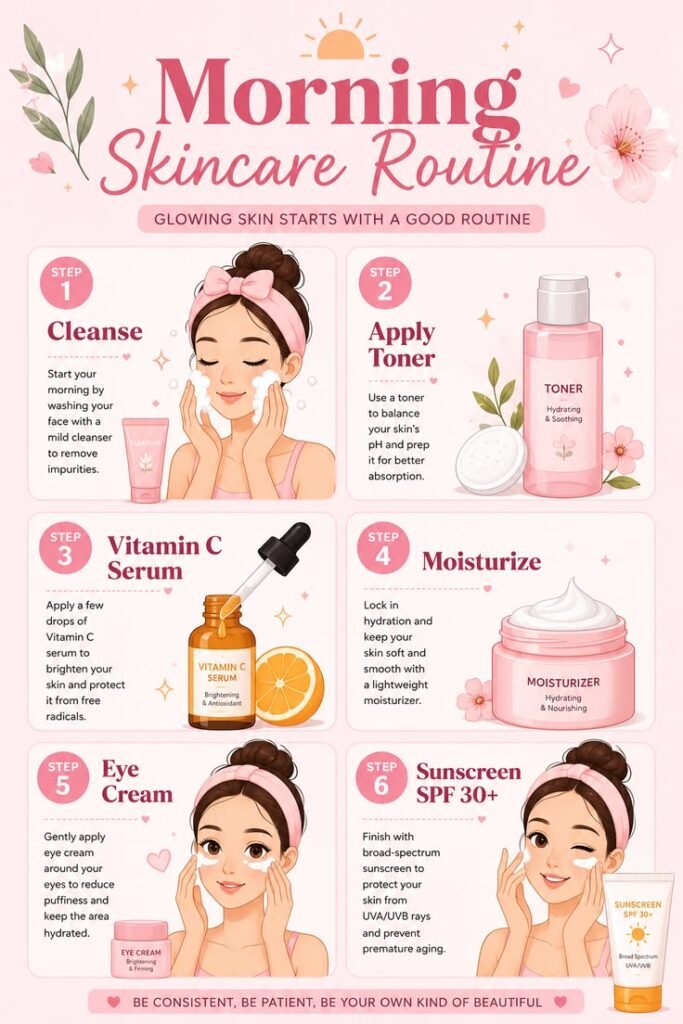
Step 1: Cleanse: Use a gentle cleanser to remove overnight oil buildup; nothing aggressive since skin hasn’t gotten dirty overnight.
Step 2: Toner: Apply toner to balance your skin PH.
Step 3: Treat: Apply a vitamin C serum or antioxidant treatment to defend against daytime environmental stress.
Step 4: Moisturize: Lock in hydration with a lightweight, non-greasy moisturizer.
Step 5: Eye cream: Gently apply eye cream around your eyes to reduce puffiness and keep hydrated.
Step 6: Protect: Apply broad-spectrum sunscreen, SPF 30 or higher. This is the single most important step in any morning skincare routine.
Night Skincare Routine Steps
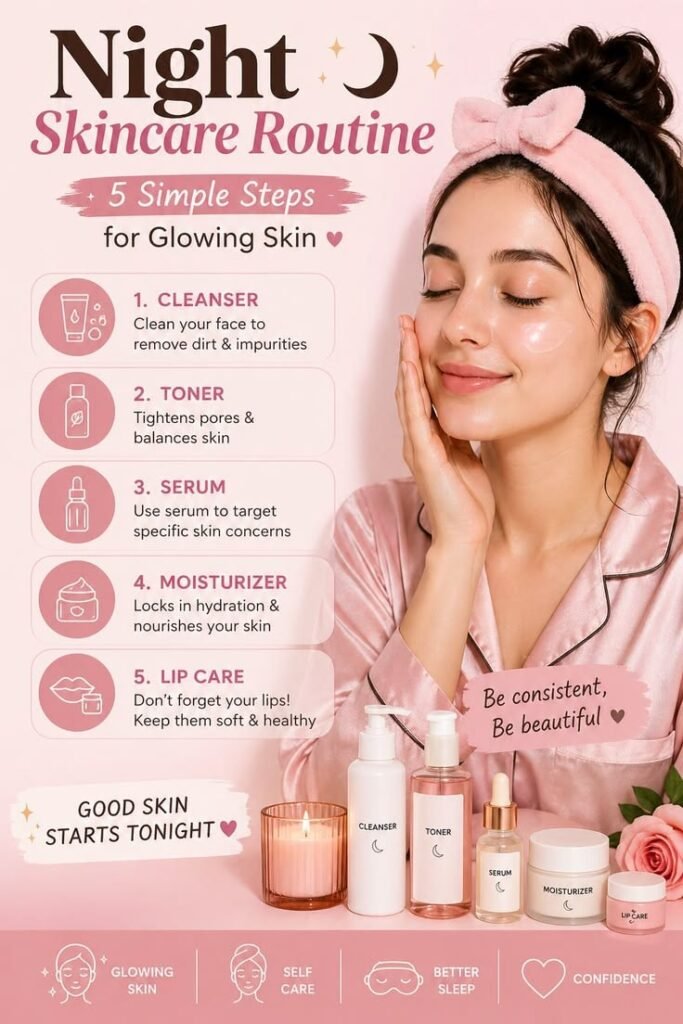
Step 1: Double Cleanse: Start with an oil-based cleanser to dissolve sunscreen and makeup, then follow with a water-based cleanser.
Step 2: Toner: tightens pores and balances the skin .
Step 3 : Treatment Serum: target the specific skin concerns. Niacinamide helps control oil and reduce dark spots. Salicylic acid helps unclog pores and prevent breakouts. Retinol, exfoliating acids, or targeted acne treatments go on, since skin repairs itself overnight.
Step 4: Moisturize: Use a slightly richer night moisturizer to support the skin’s repair cycle while you sleep. Moisturizer locks in moisture and hydrates your skin.
Step 5: Lip Care: Do not forget your lips; scrub them and apply lip oil to hydrate and keep them soft and healthy.
Expert Insight: Applying retinol before moisturizer, not after, is a common debate. For beginners with sensitive skin, the “sandwich method,” moisturizer, then retinol, then another layer of moisturizer, reduces irritation while easing skin into a skincare routine with retinol.
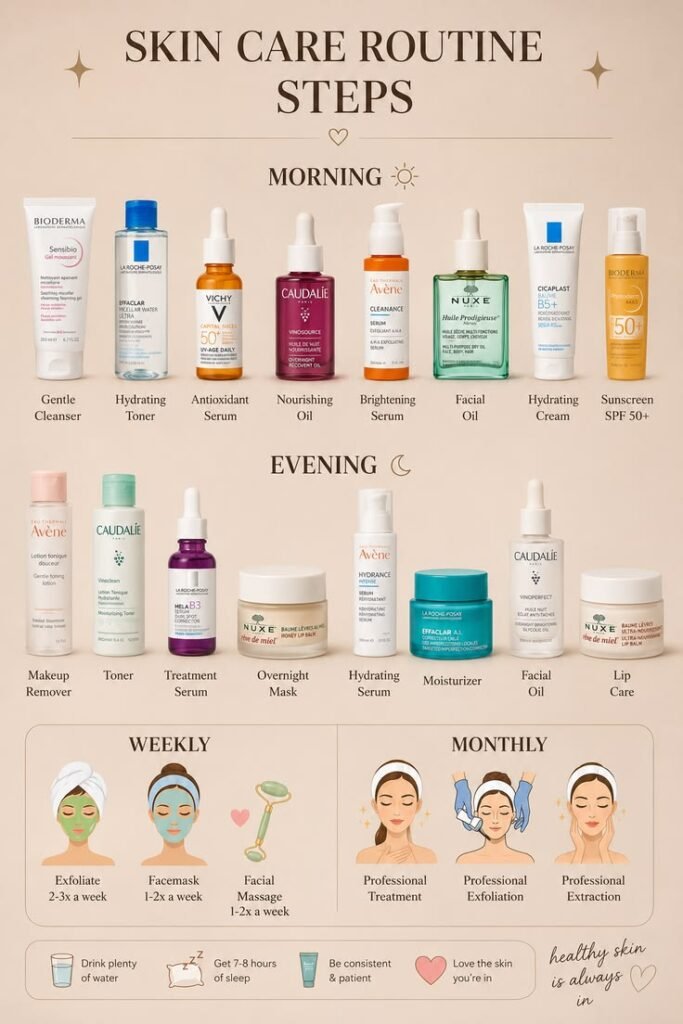
Skincare Routine Guide | Morning, Evening, Weekly & Monthly Steps
Discover the correct order of your morning and evening skincare routine, plus weekly treatments and monthly skin maintenance. Save this for a healthier, brighter, and glowing complexion every day!
Best Skincare Products for Each Step
Not every product marketed to you belongs in your skincare routine. Below is a realistic breakdown of what’s essential, what’s optional, and what’s often unnecessary.
| Product Category | Key Feature | Best For | Price Range (USD) | Rating |
|---|---|---|---|---|
| Gentle Gel Cleanser | Removes oil without stripping | Oily & combination skin | $10–$20 | 4.6/5 |
| Cream Cleanser | Hydrating, low-irritation formula | Dry & sensitive skin | $12–$25 | 4.5/5 |
| Vitamin C Serum | Antioxidant, brightening | All skin types (AM use) | $18–$40 | 4.4/5 |
| Retinol Serum | Cell turnover, anti-aging | Aging & acne-prone skin | $15–$45 | 4.7/5 |
| Broad-Spectrum SPF 30+ | UV protection | Everyone, every day | $12–$30 | 4.8/5 |
Winner: If you can only invest in one product, make it the broad-spectrum sunscreen. It has the highest long-term impact on skin health of anything on this list, and dermatologists consistently rank it as non-negotiable.
9 Common Skincare Mistakes to Avoid
The biggest skincare mistakes are not about which products you buy; they’re about how and when you use them . Avoid these common skincare mistakes to keep your skin healthy, clear, and glowing. Learn what not to do, including skipping sunscreen, over-exfoliating, sleeping with makeup, and using too many products. Save this guide for your daily beauty routine!
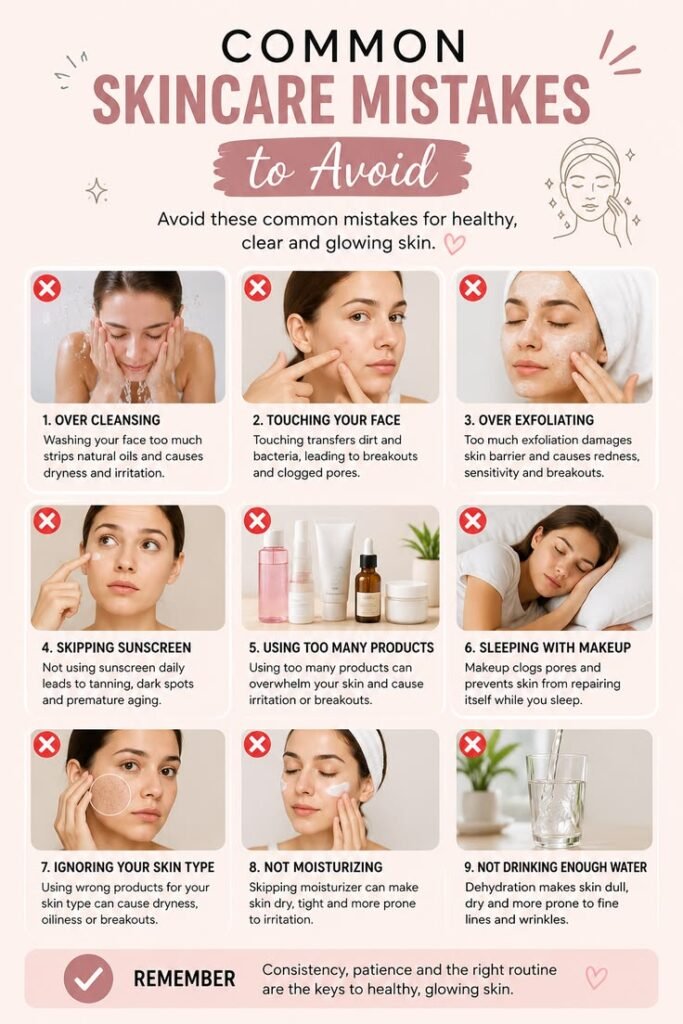
- Over-exfoliating: Using acids or scrubs daily damages the skin barrier instead of improving texture
- Over-cleansing: washing your face too much strips the natural oils from your face and causes dryness.
- Skipping sunscreen on cloudy days:UV rays penetrate clouds; skipping SPF undoes other routine steps
- Layering too many actives at once: Mixing retinol, vitamin C, and exfoliating acids in the same session causes irritation
- Switching products too often: Skin needs 4 to 6 weeks to show results; constant switching resets progress
- Applying products in the wrong order: Thick products applied before thin ones block absorption.
- Ignoring your skin type: Using the wrong products for your skin type can cause dryness, oiliness, or breakouts
- Not drinking enough water: Dehydration makes your skin dull, dry and more prone to fine lines and wrinkles
- Skip Moisturizer: Skipping moisturizer can make your skin dry, tight, and prone to irritation.
Case Study: A reader who wrote into our advice column had been using six different active ingredients simultaneously, hoping to speed up results, and instead developed persistent redness and sensitivity. After simplifying to a simple skincare routine at home with just a cleanser, one active ingredient at a time, moisturizer, and sunscreen, her skin calmed down within three weeks and texture improved within six.
Correct Skin Care Routine Order
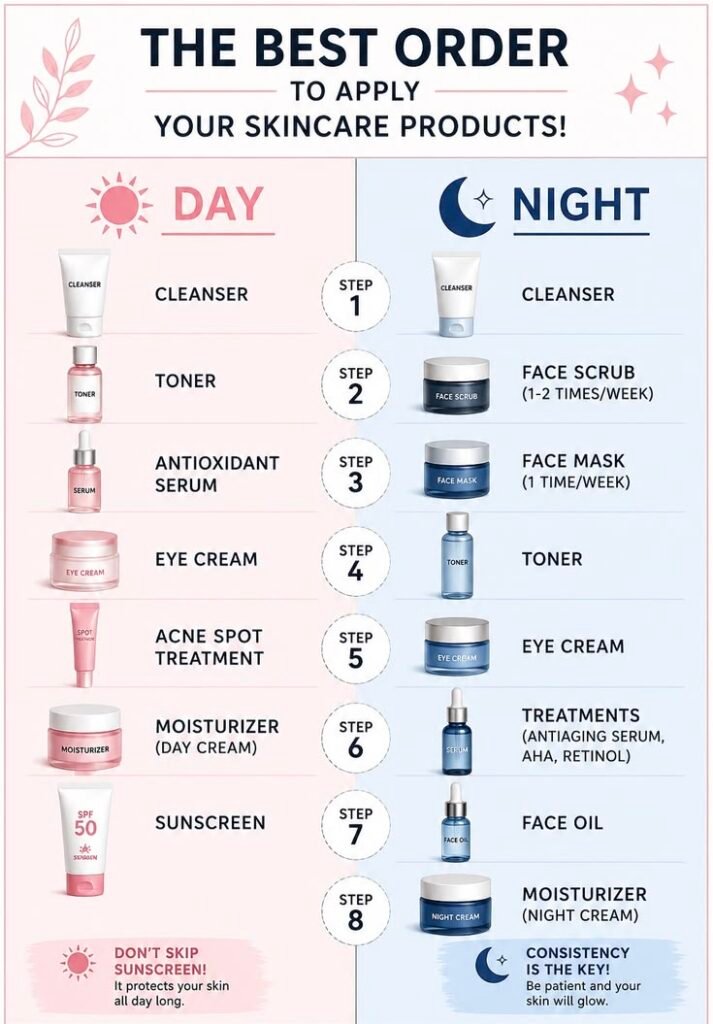
Not sure which skincare product to apply first? Follow this simple day and night skincare routine to get the most out of your cleanser, toner, serum, moisturizer, and sunscreen. Save this routine!
Skincare Routine vs. Minimalist Skincare
Some people thrive on a multi-step routine; others do better with fewer products used consistently. Here’s how the two approaches compare.
| Approach | Steps Involved | Best For | Time Commitment | Result Speed |
|---|---|---|---|---|
| Full Skincare Routine | 6–8 steps (double cleanse, treatments, layers) | Skincare enthusiasts, specific concerns | 10–15 min per session | Faster targeted results |
| Minimalist Routine | 3–4 steps (cleanse, treat, moisturize, SPF) | Beginners, busy schedules, sensitive skin | 3–5 min per session | Slower but sustainable |
Neither approach is objectively better. The right one is whichever version of a skincare routine you’ll actually follow every single day.
Expert Tips to Master Your Skincare Routine
We call this framework The Skincare Consistency Ladder, a four-rung method for building a routine that survives real life instead of falling apart after two weeks.
- Rung 1: Non-negotiables: Cleanser, moisturizer, sunscreen. Never skip these, no matter how tired you are.
- Rung 2: One active ingredient: Add a single treatment, retinol, vitamin C, or an acid, once your non-negotiables are automatic.
- Rung 3: Targeted extras: Eye cream, spot treatments, or masks, layered in only once the first two rungs are habitual.
- Rung 4: Seasonal adjustments: Swap richness and hydration levels with the seasons, lighter in summer, richer in winter.
Pro Tip: Most routines fail at Rung 2 because people add three actives at once instead of one. Patience at this stage prevents irritation later.

Real-World Examples: Before and After

Before: A 29-year-old reader with combination skin was using eight products daily, layered in no particular order, and experiencing frequent breakouts along her jawline.
After: Within eight weeks of switching to a structured skincare routine for beginners built on The Skincare Consistency Ladder- cleanser, one treatment, moisturizer, and daily SPF- her breakouts reduced significantly and her skin tone evened out.
This kind of transformation is common. It rarely comes from a new miracle product. It comes from structure and consistency.
FAQ
What is a skincare routine?
A skincare routine is a consistent, ordered set of skincare steps used daily to clean, treat, moisturize, and protect the skin. It typically includes a morning and a night version, each with a slightly different focus.
How do I start a skincare routine?
Start with just three products: a gentle cleanser, a basic moisturizer, and daily sunscreen. Once that habit sticks for two to three weeks, add one targeted treatment for your main skin concern.
What is a skincare routine for beginners step by step?
Cleanse, moisturize, and apply sunscreen in the morning. At night, cleanse and moisturize again. Add a single active ingredient like retinol only after this basic sequence feels automatic.
Is a skincare routine worth it?
Yes, a consistent skincare routine is one of the most reliable ways to improve skin texture, reduce breakouts, and slow visible aging, largely because of daily sun protection and steady hydration.
What is the best skincare routine for glowing skin?
The best skincare routine for glowing skin combines gentle exfoliation, a vitamin C serum in the morning, consistent hydration, and daily SPF. Glow comes from healthy skin barrier function, not from any single “miracle” product.
How much does a skincare routine cost?
A basic, effective skincare routine can cost as little as $40 to $60 for a cleanser, moisturizer, and sunscreen. Adding treatments like retinol or vitamin C can push monthly costs to $80 to $120 depending on brand.
What is the difference between a morning and night skincare routine?
A morning skincare routine emphasizes protection, ending with sunscreen, while a night skincare routine emphasizes repair, using treatments like retinol that work best without sun exposure.
Can a skincare routine help with acne?
Yes, a well-structured skincare routine helps manage acne by keeping pores clear through gentle cleansing and targeted treatments, though persistent or severe acne should also be evaluated by a dermatologist.
What is a simple skincare routine at home without many products?
A simple skincare routine at home needs only four items: a gentle cleanser, a hydrating moisturizer, a broad-spectrum sunscreen for daytime, and one treatment product added gradually.
How do I add retinol to my skincare routine?
Introduce retinol two to three nights a week at first, always followed by moisturizer, and increase frequency gradually over several weeks as your skin builds tolerance.
Conclusion
A good skincare routine isn’t about owning the most products; it’s about using the right few consistently, in the correct order. Focus on the non-negotiables first: gentle cleansing, daily moisturizer, and sunscreen every single morning. Add treatments like retinol or vitamin C only once those basics are automatic, and give any new skincare routine at least six weeks before judging results.
Next Steps:
- Simplify your current routine down to four core products this week
- Introduce one new active ingredient at a time, never several at once
- Commit to daily sunscreen, even on cloudy days, for the next 30 days
Sources & Methodology
This guide was compiled using dermatology guidance from the American Academy of Dermatology, informal reader survey data collected through our beauty newsletter audience, and editorial review by our beauty content team. All product pricing reflects approximate 2026 U.S. retail ranges and may vary by retailer.
Sources:
- American Academy of Dermatology, sunscreen and photoaging guidance, 2025
- Reader survey conducted by our editorial team, 2026
- Wikipedia: Skin care
About the Author
SARWAT ADIL is a l beauty writer with over 5 years of experience helping readers build sustainable skincare routines. She has contributed skincare content to several beauty and lifestyle publications and holds certifications in cosmetic skincare. This article was written based on hands-on product testing, dermatology guidance, and reader feedback collected through our editorial newsletter, and was fact-checked by our beauty editorial team before publication.




Post Comment